
Looking to buy? See our books on amazon.com Get Reading Now! Age of Aces Presents - free pulp PDFs

My Most Thrilling Sky Fight: Baron Manfred von Richthofen

Link - Posted by David on January 13, 2016 @ 6:00 am in

Amidst all the great pulp thrills and features in Sky Fighters, they ran a true story feature collected by Ace Williams wherein famous War Aces would tell actual true accounts of thrilling moments in their fighting lives! This week we have the legend that is Baron Manfred von Richthofen!

Captain Manfred von Richthofen was the greatest of all the German flyers. He had more victories to his credit than any other battle flyer. He began in the Imperial Flying Corps, on the Russian Front. Soon afterwards he was transferred to the German North Seas station at Ostend, where he served as a bomber. Backseat flying never appealed to him, so he took training, soon won his wings, and was sent to join the jagdstaffel commanded by Oswald Boelke. After his sixteenth victory, he was promoted to Lieutenant and assigned to command a squadron. This became the Flying Circus, the most famous of all the German squadrons, the scourge of the western skies.
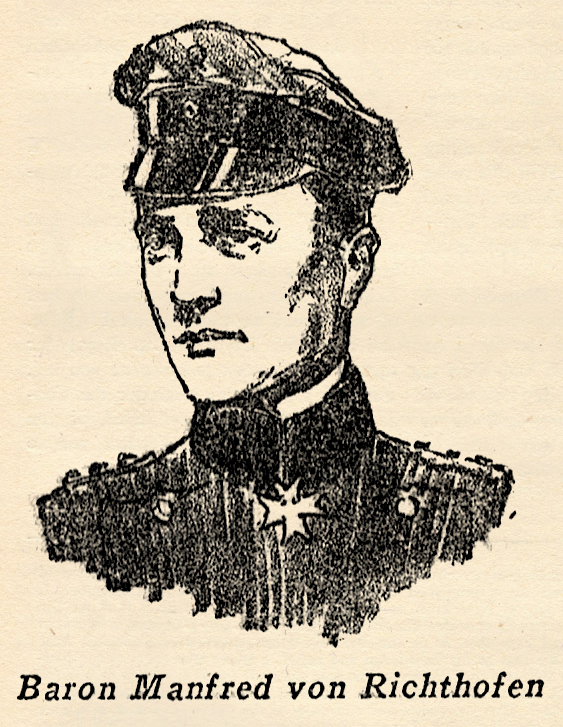
The account below, in which he describes his flight with Major Hawker, the famous British Ace, on November 3, 1916, is from Richthofen’s personal memoirs. For this victory he was awarded the order of Pour le Merite. Only Immelmann and Boelke before him had gained this honor, and no air fighter following him over received it. In his scarlet red battle plane he coursed the Western Front from end to end, strewing death and destruction in his wake—until that fatal day when bullets from a British flyer’s gun brought him to his end, as he had brought upwards of a hundred others.


DOWNING A BRITISH ACE

by Baron Manfred von Richthofen • Sky Fighters, February 1934

I WAS flying along with my patrol of three wing-mates when I noticed three Englishmen. They looked me over keenly in the manner of stalkers looking for cold meat. I was far below the rest of my patrol flying above, so I sensed that they had only spied me and not the others. I let them think I was flying alone and boldly flaunted my wings in challenge.

They had the ceiling, so I had to wait until one of them dropped on me before shifting for attack myself. Down one came presently, streaking in a line for my tail. At a close range, he opened up. But I banked swiftly and escaped the burst, intending to nose back and get in one of my own as he swooped past. But he banked, too, sticking on my tail. Round and round we circled like madmen, each trying to catch up with the other at an altitude of 10,000 feet.

First we circled about twenty times to the left. Then reversed and circled thirty times to the right, each trying to tighten the circle sufficiently to line in a burst—but without success. I knew then this fellow I had so boldly tackled wasn’t any beginner. He had no intentions of breaking or running. And his machine was a marvelous stunter (D.H.2 with 100 h.p. mono-soupape motor—Editor). However, mine climbed better than his, so I succeeded finally in getting above and behind my dancing partner.

When we had settled down to 6,000 feet with the battle still a draw, my opponent should have had sense enough to leave, for we were fighting over my own territory. But he held on like a leech.

At 3,000 feet we were still battling for position with guns silent, neither of us having been able to line the other in his sights. My opponent looked up from his pit, smiled. He was a good sportsman.

We made twenty or thirty more circles, getting lower and lower. Looking down in my opponent’s pit I sized him up carefully, expecting some trick. He had to do something, for I was continually pressing him down, and he had to decide between landing in German territory or making a run for his own lines.

He looped suddenly trying to get on my tail. His guns blasted simultaneously. Bullets flew around me, crackling and whining. Coming out of the loop just off the ground he darted off in a zig-zag course. That was my most favorable moment.

I pounced on his tail, firing with all I had from a distance between 150 and 250 feet away. His machine simply could not help falling. My bullets poured through it in a steady stream.

At that the jamming of my guns almost robbed me of victory, but just at that moment his plane toppled off on one wing and slid into the ground just 150 feet behind our lines.

When I landed, I found that one of my bullets had passed through his head. How he managed to duck all but that one was more than I could understand—until I learned later that my victim was the famous Major Hawker!
“Sky Fighters, February 1934″ by Eugene M. Frandzen

Link - Posted by David on January 11, 2016 @ 6:00 am in

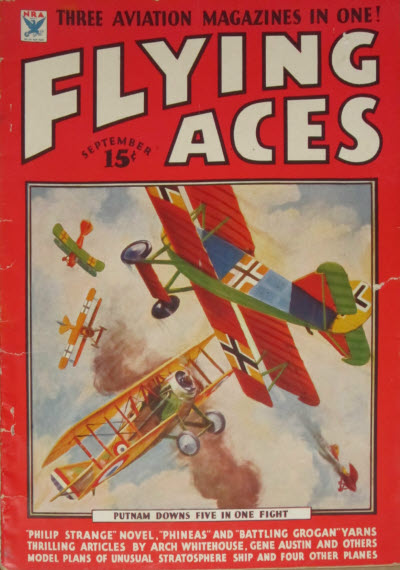
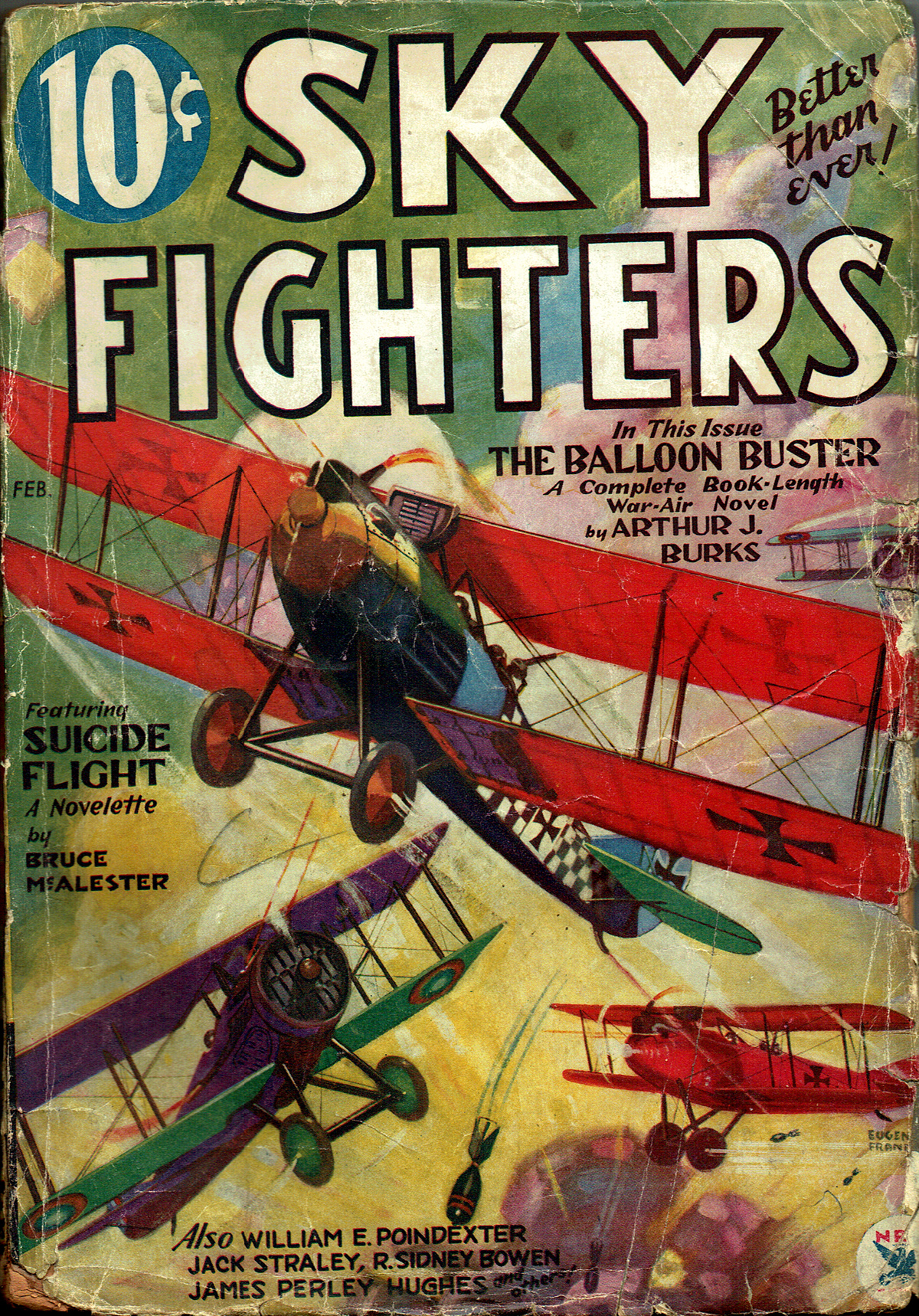
This week we have the cover of Sky Fighters from February 1934 by our old friend Eugene Frandzen. Franzen painted the covers of Sky Fighters from its first issue in 1932 until he moved on from the pulps in 1939. At this point in the run, the covers were about the planes featured on the cover more than the story depicted.

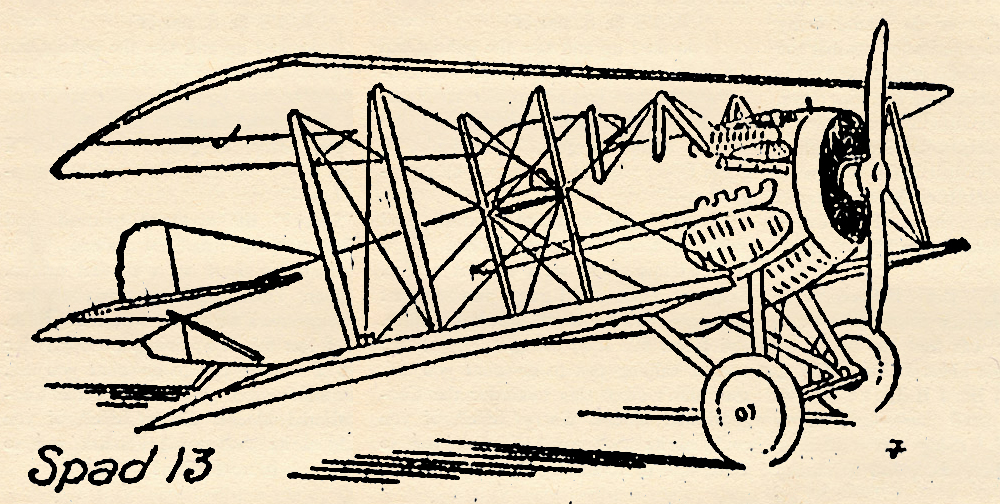
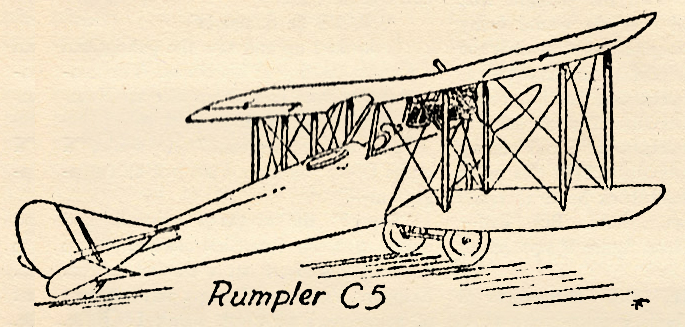
THE SHIPS pictured th_SF_3402on this month’s cover are the German Rumpler type C5 and the French Spad type 13.

The Rumpler was one of Germany’s most successful war planes. As far back as 1908 Herr E. Rumpler was working on airplane designs. At first his ships followed closely the Eitrich “Taube” design, that queer birdlike swept-back wing construction. In a Rumpler biplane an eighteen-hour record was established just before the war by Herr Basser who flew from Berlin to Constantinople, making only three stops.

This flight was phenomenal for those days and it was only natural that when the World War flared and burst over nearly all Europe that the German High Command would do plenty of concentrating on their prize-winning Rumpler. It eventually lost its swept-back wings but the general appearance of the fuselage and nose remained the same up to the end of the war.

The two Rumpler C5s pictured on the cover are equipped for light bombing. Their speed was around 105 to 110 m.p.h.

From the blast of the explosion coming from the bottom of the picture it looks as though they have caused plenty of trouble. When we consider that the bill for the World War amounted to about 186 billion dollars and that plenty of that sweet little amount went into explosives of assorted shapes and potency one little ammunition dump valued at a few hundred thousand dollars doesn’t amount to much on the books, but add a few of these dumps together along a front that is causing the opposing power plenty of headaches and you’ll easily see how extremely important a little bomb-dropping party really is.

That in exactly what is happening in the picture—an ammo dump has gone blooey. One bomb beautifully spotted by the leading Rumpler pilot has done the trick. His pardner in the background is shedding his load of eggs in a businesslike manner too. The odds are against the Allies in this particular instance. They will have to rush some fresh ammunition to this particular sector if they want to have sufficient food for their hungry cannons.

But don’t overlook that Spad coming in with both guns blazing at the Rumpler. It didn’t get there quite in time to drive the Fritz away before he could shed his bombs but if a stray hunk of exploding shell from the dump doesn’t get one of the Spad pilots it will just be too bad for the men in the German ships.

This Spad 13 could kick off about 130 to 135 miles per hour. It carried plenty of horsepower up front in its nose, 220 to be exact. The ambitious pilots of the bomb-dropping Rumplers are quite some distance behind the Allied lines. Their protection planes are far behind the German lines. And those two Spads will either herd the Germans down to the ground or blow them out of the sky.

Bombing ammunition dumps during the World War was done extensively by both sides. Many times the pilot and observer of a two-seater plane went on a special ammunition-bombing expedition from which they knew they would never return.

They had specific jobs to accomplish and they grinned, smoked a last cigarette and flew their ships to the spot indicated on their maps. Usually a one-way trip, but if the mission was successful thousands of lives were saved.

The Ships on The Cover
Sky Fighters, February 1934 by Eugene M. Frandzen
(The Ships on The Cover Page)

Next time, Mr. Frandzen features the Morane-Saulnier Parasol (type P)!

“Scrappy Birthday” by Joe Archibald

Link - Posted by David on January 1, 2016 @ 6:00 am in

“Haw-w-w-w-w!” That sound can only mean one thing—it’s time to ring out the old year and ring in the new with that Bachelor of Artifice, Knight of Calamity and an alumnus of Doctor Merlin’s Camelot College for Conjurors—Phineas Pinkham. And it’s a festive one—It’s Major Rufus Garrity’s birthday and he’d like to keep it a secret, but it’s impossible to keep a secret from the Boonetown marvel!
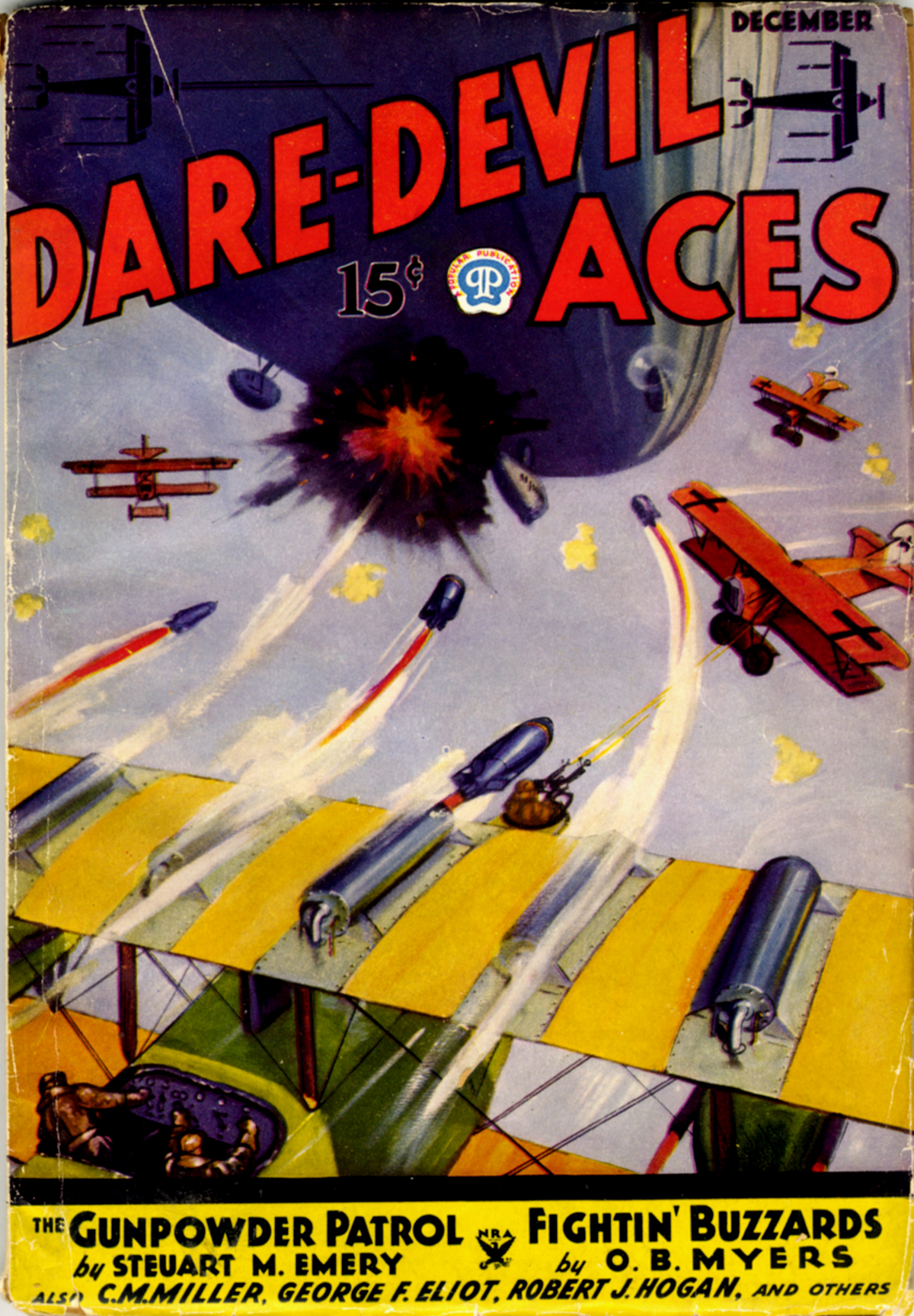
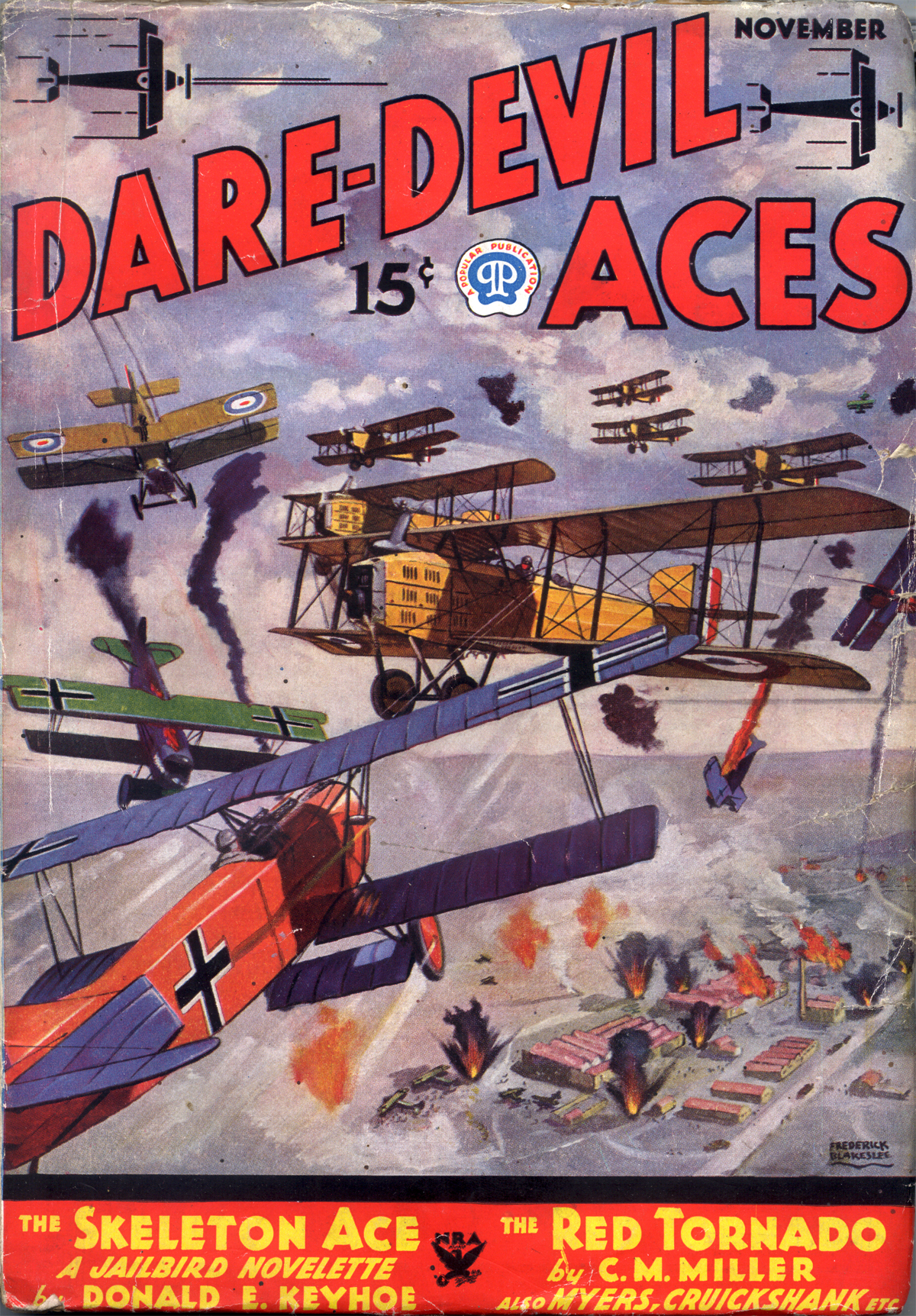
It was a big anniversary for Major Garrity, and Phineas Pinkham wanted to wish him a happy birthday. Well, it wasn’t entirely Phineas’ fault that what he wished him was a Scrappy Birthday!

“The Flying Torpedo” by Frederick Blakeslee

Link - Posted by David on July 13, 2015 @ 6:00 am in

Frederick Blakeslee painted all the covers for the entire run of Dare-Devil Aces. And each of those covers had a story behind it. Blakeslee had three different formats for his stories behind his covers. First, there’s the straight story of the cover action; second, there was the ship on the cover where he told the specifics of the plane featured on said cover; and then there were future visions of air warfare. This week we have the first of these where he talks about the flying torpedo—or guided missle! From the December 1934 issue of Dare-Devil Aces—

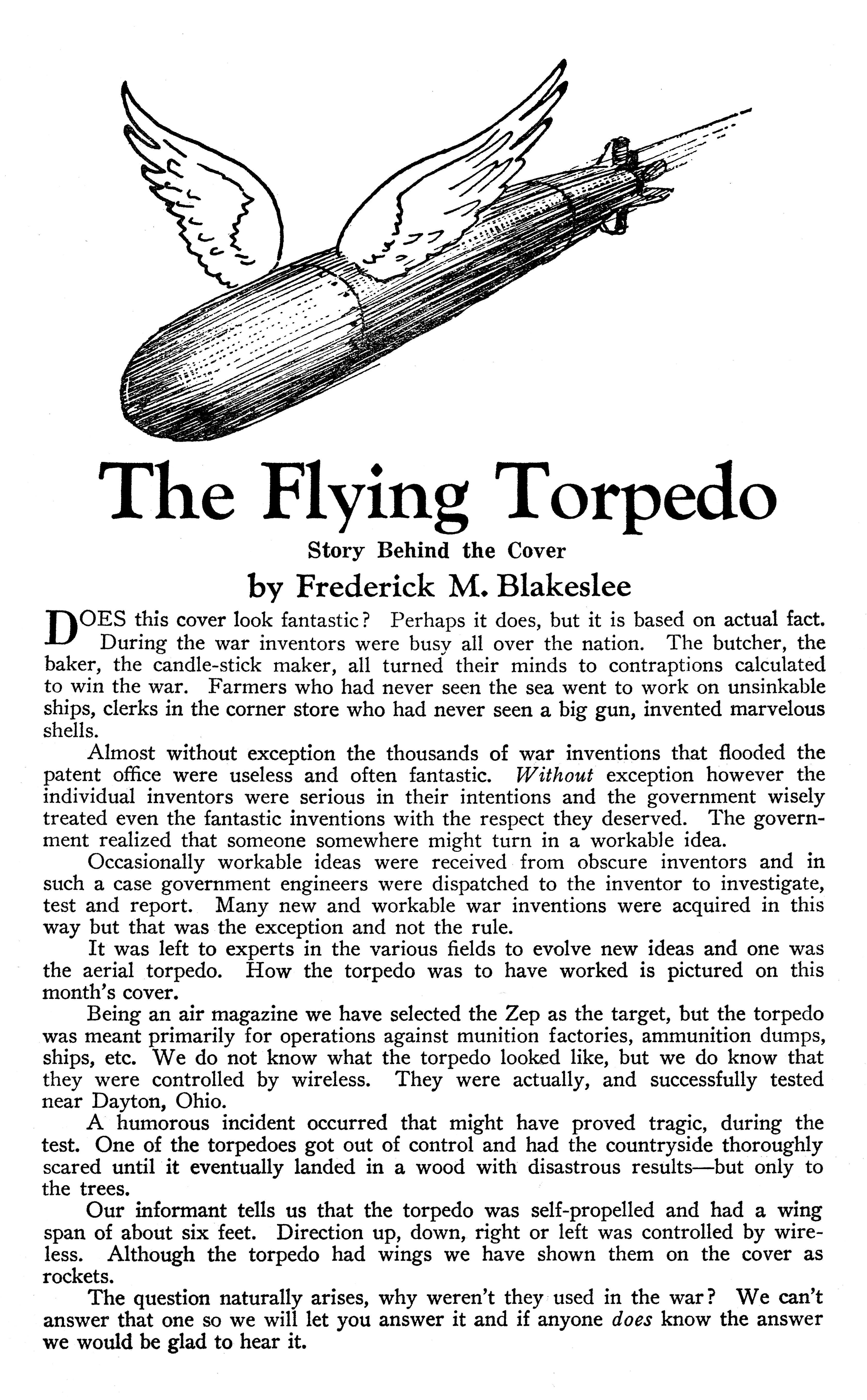
th_DDA_3412DOES this cover look fantastic? Perhaps it does, but it is based on actual fact.

During the war inventors were busy all over the nation. The butcher, the baker, the candle-stick maker, all turned their minds to contraptions calculated to win the war. Farmers who had never seen the sea went to work on unsinkable ships, clerks in the corner store who had never seen a big gun, invented marvelous shells.

Almost without exception the thousands of war inventions that flooded the patent office were useless and often fantastic. Without exception however the individual inventors were serious in their intentions and the government wisely treated even the fantastic inventions with the respect they deserved. The government realized that someone somewhere might turn in a workable idea.

Occasionally workable ideas were received from obscure inventors and in such a case government engineers were dispatched to the inventor to investigate, test and report. Many new and workable war inventions were acquired in this way but that was the exception and not the rule.

It was left to experts in the various fields to evolve new ideas and one was the aerial torpedo. How the torpedo was to have worked is pictured on this month’s cover.

Being an air magazine we have selected the Zep as the target, but the torpedo was meant primarily for operations against munition factories, ammunition dumps, ships, etc. We do not know what the torpedo looked like, but we do know that they were controlled by wireless. They were actually, and successfully tested near Dayton, Ohio.

A humorous incident occurred that might have proved tragic, during the test. One of the torpedoes got out of control and had the countryside thoroughly scared until it eventually landed in a wood with disastrous results—but only to the trees.

Our informant tells us that the torpedo was self-propelled and had a wing span of about six feet. Direction up, down, right or left was controlled by wireless. Although the torpedo had wings we have shown them on the cover as rockets.

The question naturally arises, why weren’t they used in the war ? We can’t answer that one so we will let you answer it and if anyone does know the answer we would be glad to hear it.

The Story Behind The Cover
“The Flying Torpedo: The Story Behind The Cover” by Frederick Blakeslee
(December 1934, Dare-Devil Aces)

Next time, Mr. Blakeslee brings us another fanciful invention—”Death Lightning” for the January 1935 cover. Be sure not to miss it.

“The Breguet” by Frederick Blakeslee

Link - Posted by David on July 6, 2015 @ 6:00 am in

Frederick Blakeslee painted all the covers for the entire run of Dare-Devil Aces. And each of those covers had a story behind it. This time, Blakeslee presents us with more of the approach he used for the covers he painted for Battle Aces—telling us about the ship on cover of the November 1934 cover for Dare-Devil Aces. . . .

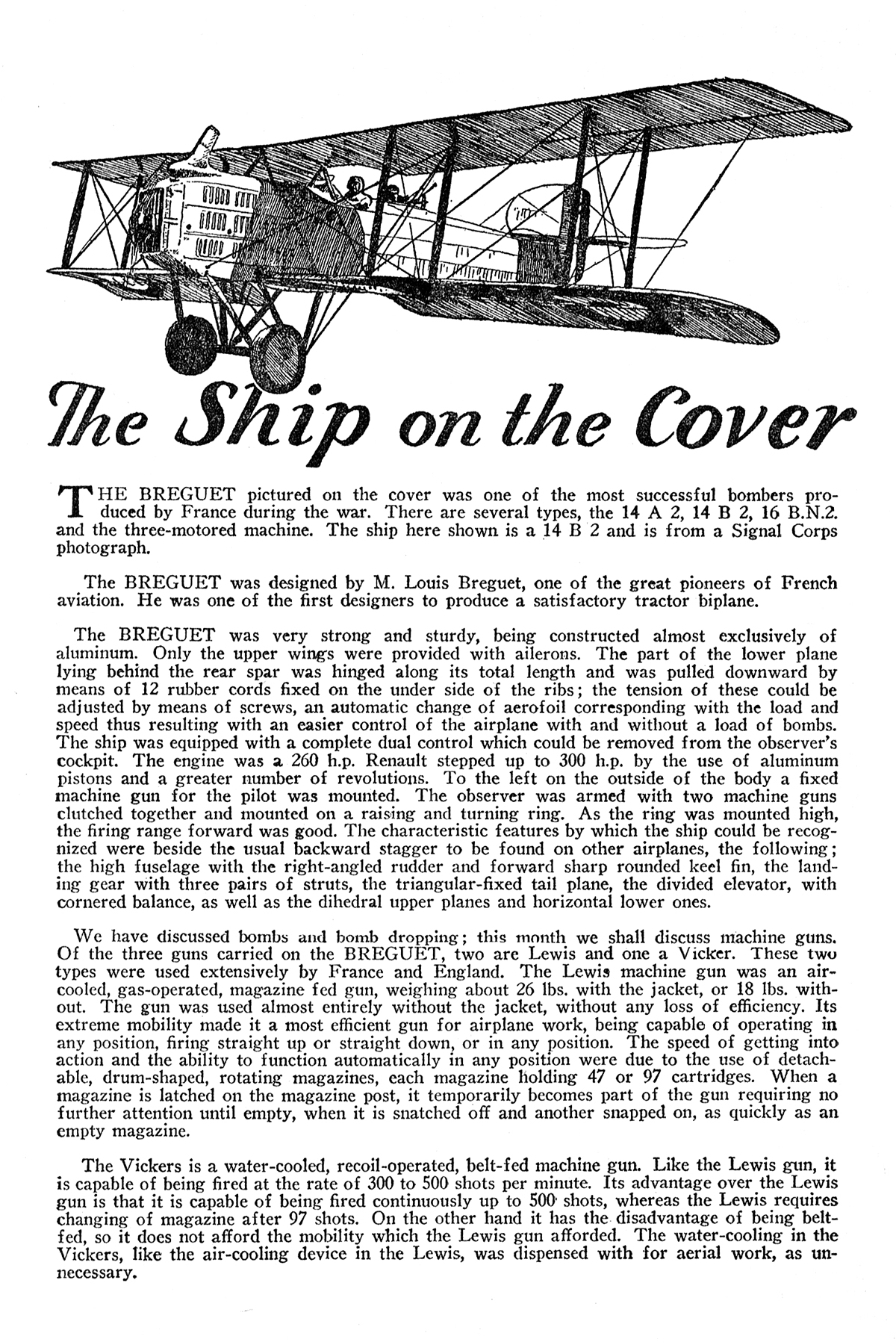
th_DDA_3411THE BREGUET pictured on the cover was one of the most successful bombers produced by France during the war. There are several types, the 14 A 2, 14 B 2, 16 B.N.2. and the three-motored machine. The ship here shown is a 14 B 2 and is from a Signal Corps photograph.

The BREGUET was designed by M. Louis Breguet, one of the great pioneers of French aviation. He was one of the first designers to produce a satisfactory tractor biplane.

The BREGUET was very strong and sturdy, being constructed almost exclusively of aluminum. Only the upper wings were provided with ailerons. The part of the lower plane lying behind the rear spar was hinged along its total length and was pulled downward by means of 12 rubber cords fixed on the under side of the ribs; the tension of these could be adjusted by means of screws, an automatic change of aerofoil corresponding with the load and speed thus resulting with an easier control of the airplane with and without a load of bombs. The ship was equipped with a complete dual control which could be removed from the observer’s cockpit. The engine was a 260 h.p. Renault stepped up to 300 h.p. by the use of aluminum pistons and a greater number of revolutions. To the left on the outside of the body a fixed machine gun for the pilot was mounted. The observer was armed with two machine guns clutched together and mounted on a raising and turning ring. As the ring was mounted high, the firing range forward was good. The characteristic features by which the ship could be recognized were beside the usual backward stagger to be found on other airplanes, the following; the high fuselage with the right-angled rudder and forward sharp rounded keel fin, the landing gear with three pairs of struts, the triangular-fixed tail plane, the divided elevator, with cornered balance, as well as the dihedral upper planes and horizontal lower ones.

We have discussed bombs and bomb dropping; this month we shall discuss machine guns. Of the three guns carried on the BREGUET, two arc Lewis and one a Vicker. These two types were used extensively by France and England. The Lewis machine gun was an air-cooled, gas-operated, magazine fed gun, weighing about 26 lbs. with the jacket, or 18 lbs. without. The gun was used almost entirely without the jacket, without any loss of efficiency. Its extreme mobility made it a most efficient gun for airplane work, being capable of operating in any position, firing straight up or straight down, or in any position. The speed of getting into action and the ability to function automatically in any position were due to the use of detachable, drum-shaped, rotating magazines, each magazine holding 47 or 97 cartridges. When a magazine is latched on the magazine post, it temporarily becomes part of the gun requiring no further attention until empty, when it is snatched off and another snapped on, as quickly as an empty magazine.

The Vickers is a water-cooled, recoil-operated, belt-fed machine gun. Like the Lewis gun, it is capable of being fired at the rate of 300 to 500 shots per minute. Its advantage over the Lewis gun is that it is capable of being fired continuously up to 500 shots, whereas the Lewis requires changing of magazine after 97 shots. On the other hand it has the disadvantage of being belt-fed, so it does not afford the mobility which the Lewis gun afforded. The water-cooling in the Vickers, like the air-cooling device in the Lewis, was dispensed with for aerial work, as unnecessary.

The Story Behind The Cover
“The Breguet: The Ship on the Cover” by Frederick Blakeslee
(November 1934, Dare-Devil Aces)

Next time, Mr. Blakeslee brings us the fanciful tale of “The Flying Torpedo” for the December 1934 cover. Be sure not to miss it.

“T.N.T. Wings” by Eliot Todd

Link - Posted by David on June 29, 2015 @ 6:00 am in

Frederick Blakeslee painted all the covers for the entire run of Dare-Devil Aces. And each of those covers had a story behind it. This time, Eliot Todd recounts the story behind Blakeslee’s October 1934 cover for Dare-Devil Aces. . . .

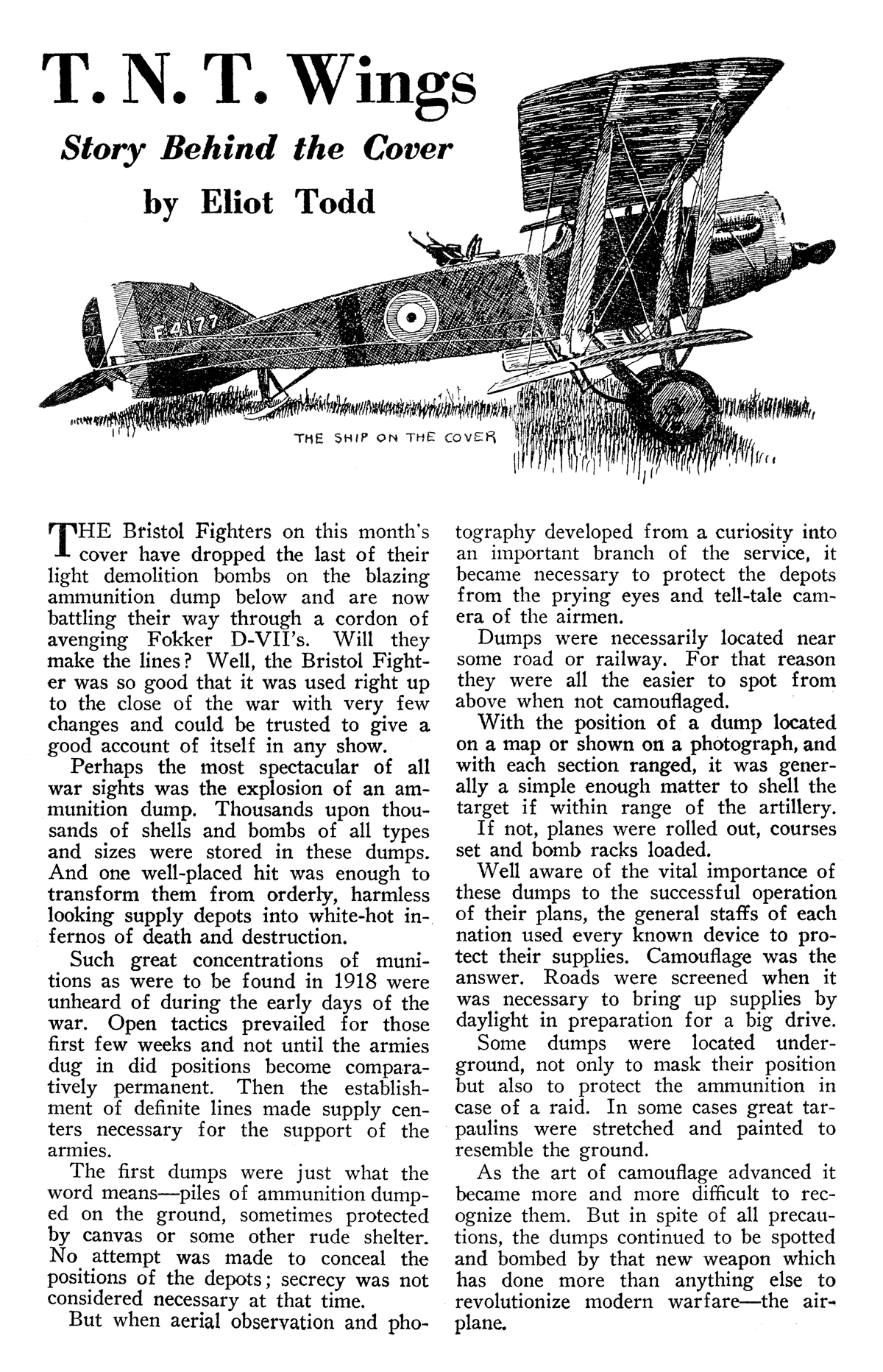
th_DDA_3410THE Bristol Fighters on this month’s cover have dropped the last of their light demolition bombs on the blazing ammunition dump below and are now battling their way through a cordon of avenging Fokker D-VII’s. Will they make the lines? Well, the Bristol Fighter was so good that it was used right up to the close of the war with very few changes and could be trusted to give a good account of itself in any show.

Perhaps the most spectacular of all war sights was the explosion of an ammunition dump. Thousands upon thousands of shells and bombs of all types and sizes were stored in these dumps. And one well-placed hit was enough to transform them from orderly, harmless looking supply depots into white-hot infernos of death and destruction.

Such great concentrations of munitions as were to be found in 1918 were unheard of during the early days of the war. Open tactics prevailed for those first few weeks and not until the armies dug in did positions become comparatively permanent. Then the establishment of definite lines made supply centers necessary for the support of the armies.

The first dumps were just what the word means—piles of ammunition dumped on the ground, sometimes protected by canvas or some other rude shelter. No attempt was made to conceal the positions of the depots; secrecy was not considered necessary at that time.

But when aerial observation and photography developed from a curiosity into an important branch of the service, it became necessary to protect the depots from the prying eyes and tell-tale camera of the airmen.

Dumps were necessarily located near some road or railway. For that reason they were all the easier to spot from above when not camouflaged.

With the position of a dump located on a map or shown on a photograph, and with each section ranged, it was generally a simple enough matter to shell the target if within range of the artillery.

If not, planes were rolled out, courses set and bomb racks loaded.

Well aware of the vital importance of these dumps to the successful operation of their plans, the general staffs of each nation used every known device to protect their supplies. Camouflage was the answer. Roads were screened when it was necessary to bring up supplies by daylight in preparation for a big drive.

Some dumps were located underground, not only to mask their position but also to protect the ammunition in case of a raid. In some cases great tarpaulins were stretched and painted to resemble the ground.

As the art of camouflage advanced it became more and more difficult to recognize them. But in spite of all precautions, the dumps continued to be spotted and bombed by that new weapon which has done more than anything else to revolutionize modern warfare—the airplane.

The Story Behind The Cover
“T.N.T. Wings: The Story Behind The Cover” by Eliot Todd
(October 1934, Dare-Devil Aces)

Check back again. We will be presenting more Stories behind the Covers.

“The Bourges Bomber” by Frederick Blakeslee

Link - Posted by David on June 22, 2015 @ 6:30 am in

Frederick Blakeslee painted all the covers for the entire run of Dare-Devil Aces. And each of those covers had a story behind it. This time, Blakeslee presents us with more of the approach he used for the covers he painted for Battle Aces—telling us about the ship on cover of the September 1934 cover for Dare-Devil Aces. . . .

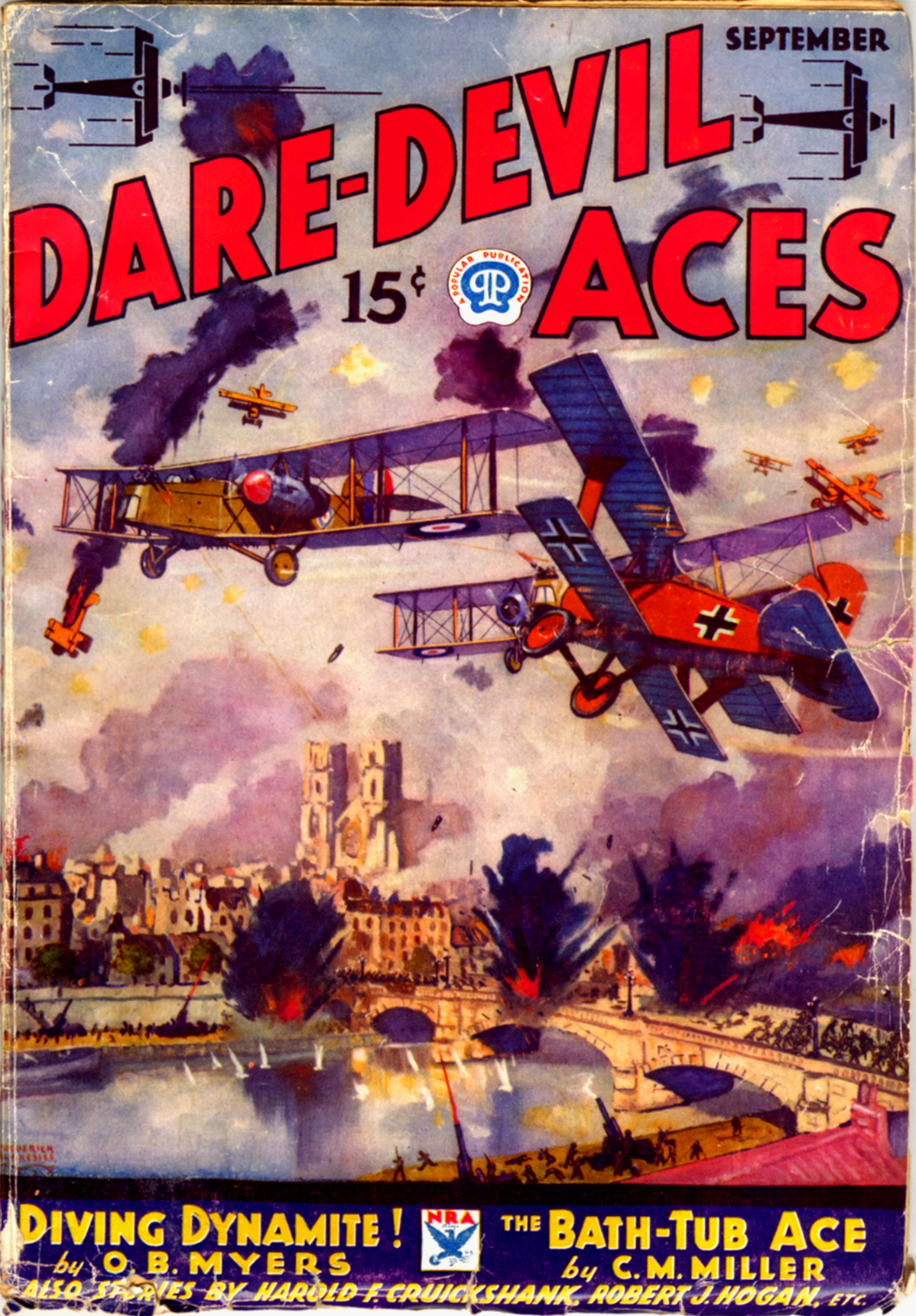
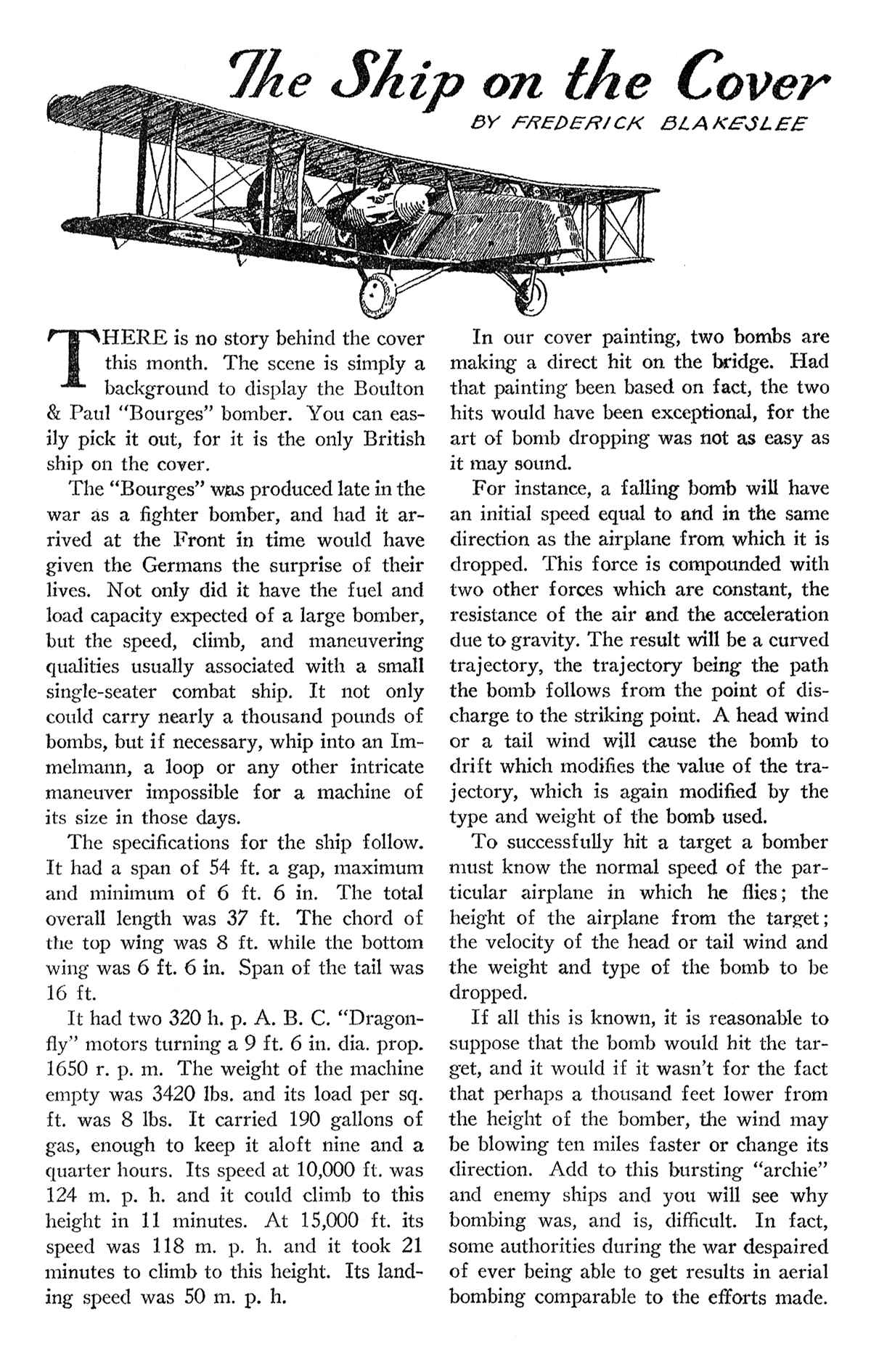
th_DDA_3409THERE is no story behind the cover this month. The scene is simply a background to display the Boulton & Paul “Bourges” bomber. You can easily pick it out, for it is the only British ship on the cover.

The “Bourges” was produced late in the war as a fighter bomber, and had it arrived at the Front in time would have given the Germans the surprise of their lives. Not only did it have the fuel and load capacity expected of a large bomber, but the speed, climb, and maneuvering qualities usually associated with a small single-seater combat ship. It not only could carry nearly a thousand pounds of bombs, but if necessary, whip into an Immelmann, a loop or any other intricate maneuver impossible for a machine of its size in those days.

The specifications for the ship follow. It had a span of 54 ft. a gap, maximum and minimum of 6 ft. 6 in. The total overall length was 37 ft. The chord of the top wing was 8 ft. while the bottom wing was 6 ft. 6 in. Span of the tail was 16 ft.

It had two 320 h.p. A. B. C. “Dragonfly” motors turning a 9 ft. 6 in. dia. prop. 1650 r.p.m. The weight of the machine empty was 3420 lbs. and its load per sq. ft. was 8 lbs. It carried 190 gallons of gas, enough to keep it aloft nine and a quarter hours. Its speed at 10,000 ft. was 124 m.p.h. and it could climb to this height in 11 minutes. At 15,000 ft. its speed was 118 m.p.h. and it took 21 minutes to climb to this height. Its landing speed was 50 m.p.h.

In our cover painting, two bombs are making a direct hit on the bridge. Had that painting been based on fact, the two hits would have been exceptional, for the art of bomb dropping was not as easy as it may sound.

For instance, a falling bomb will have an initial speed equal to and in the same direction as the airplane from which it is dropped. This force is compounded with two other forces which are constant, the resistance of the air and the acceleration due to gravity. The result will be a curved trajectory, the trajectory being the path the bomb follows from the point of discharge to the striking point. A head wind or a tail wind will cause the bomb to drift which modifies the value of the trajectory, which is again modified by the type and weight of the bomb used.

To successfully hit a target a bomber must know the normal speed of the particular airplane in which he flies; the height of the airplane from the target; the velocity of the head or tail wind and the weight and type of the bomb to be dropped.

If all this is known, it is reasonable to suppose that the bomb would hit the target, and it would if it wasn’t for the fact that perhaps a thousand feet lower from the height of the bomber, the wind may be blowing ten miles faster or change its direction. Add to this bursting “archie” and enemy ships and you will see why bombing was, and is, difficult. In fact, some authorities during the war despaired of ever being able to get results in aerial bombing comparable to the efforts made.

The Story Behind The Cover
“The Bourges Bomber: The Ship on the Cover” by Frederick Blakeslee
(September 1934, Dare-Devil Aces)

Next time, Eliot Todd returns with the story of “T.N.T. Wings” on the October 1934 cover. Be sure not to miss it.

“Suicide Buzzards” by Eliot Todd

Link - Posted by David on June 15, 2015 @ 6:00 am in

Frederick Blakeslee painted all the covers for the entire run of Dare-Devil Aces. And each of those covers had a story behind it. This time, Eliot Todd recounts the story behind Blakeslee’s July 1934 cover for Dare-Devil Aces. . . .

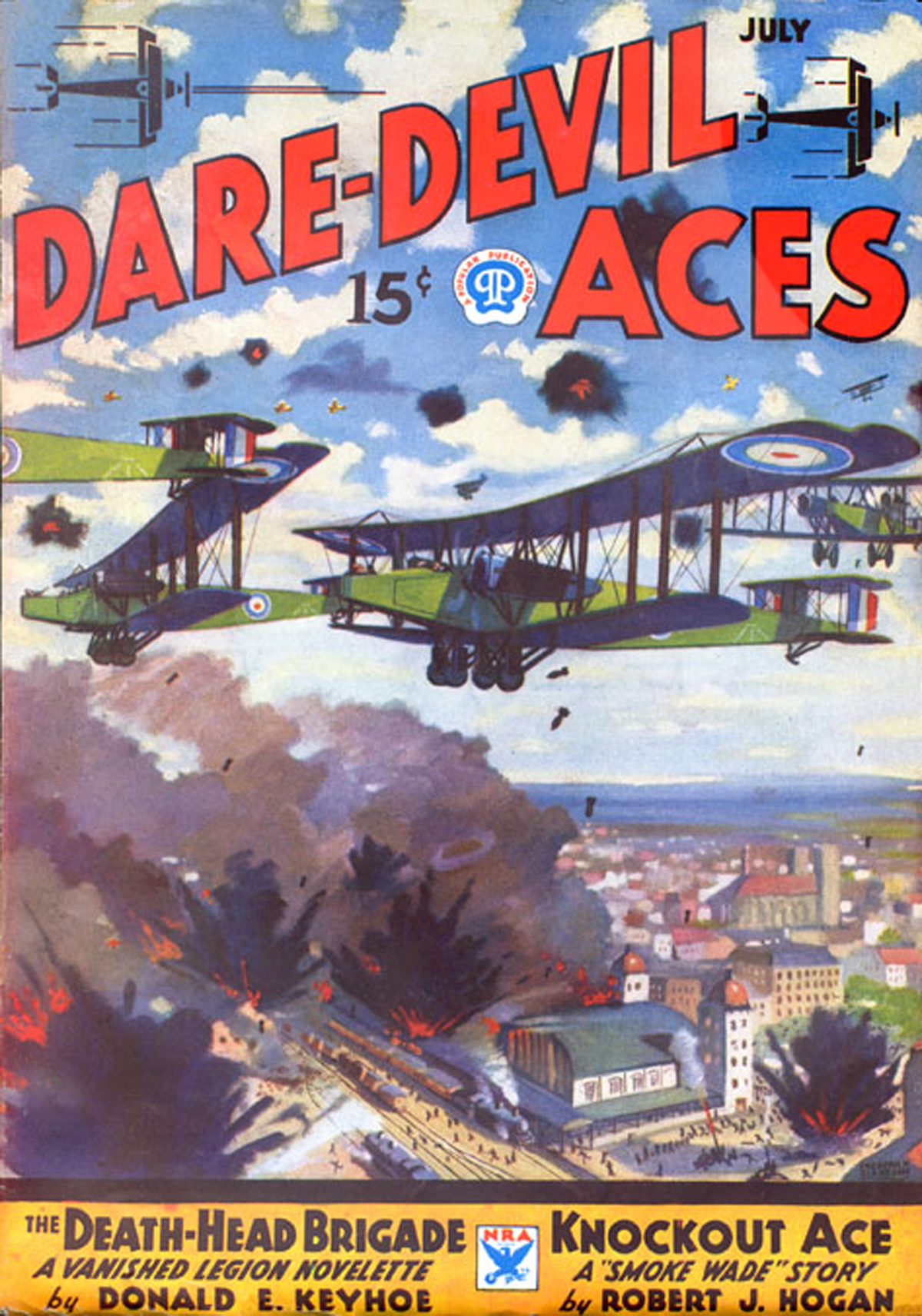
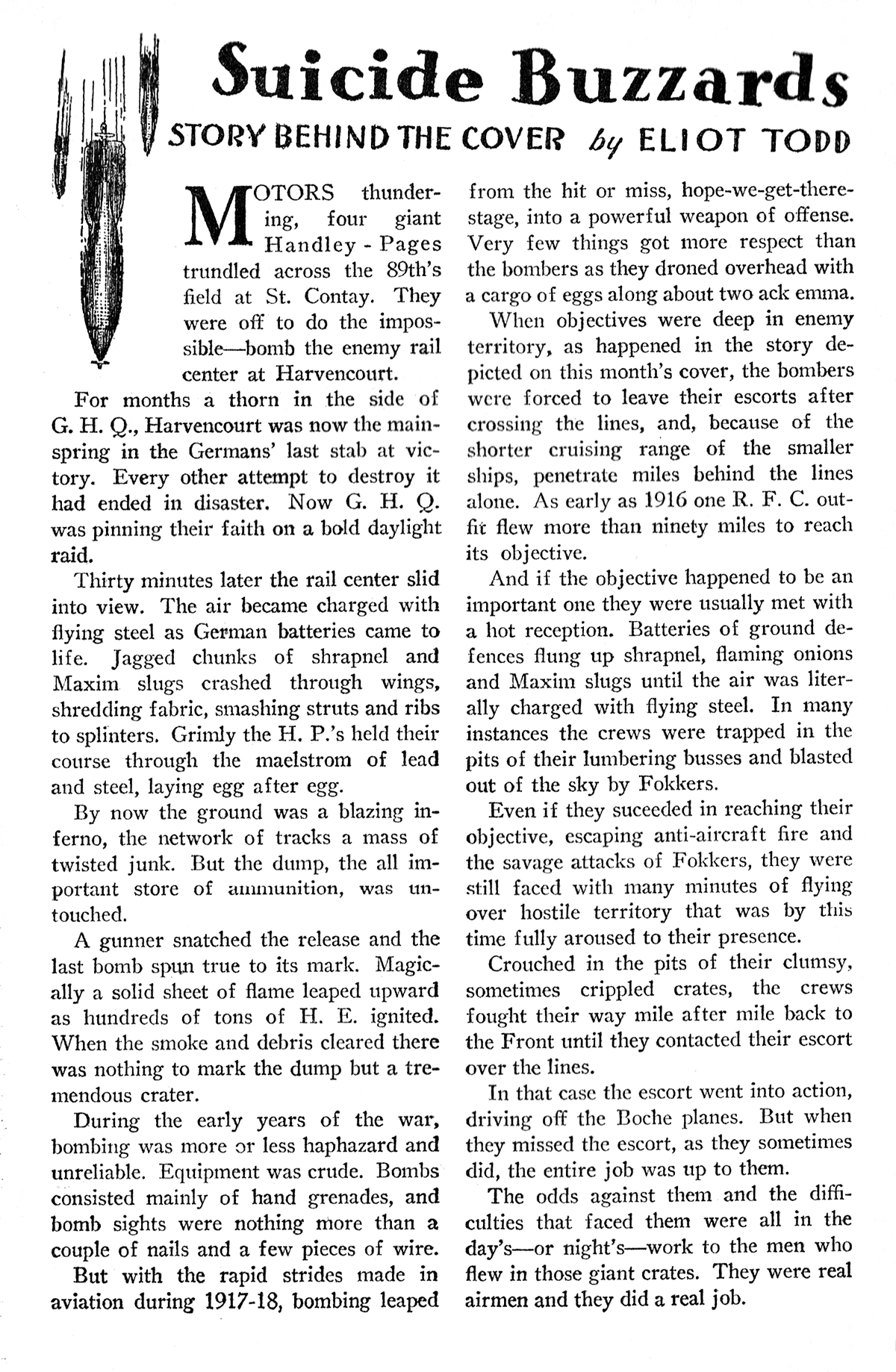
th_DDA_3407MOTORS thundering, four giant Handley-Pages trundled across the 89th’s field at St. Contay. They were off to do the impossible—bomb the enemy rail center at Harvencourt.

For months a thorn in the side of G.H.Q., Harvencourt was now the mainspring in the Germans’ last stab at victory. Every other attempt to destroy it had ended in disaster. Now G.H.Q. was pinning their faith on a bold daylight raid.

Thirty minutes later the rail center slid into view. The air became charged with flying steel as German batteries came to life. Jagged chunks of shrapnel and Maxim slugs crashed through wings, shredding fabric, smashing struts and ribs to splinters. Grimly the H.P.’s held their course through the maelstrom of lead and steel, laying egg after egg.

By now the ground was a blazing inferno, the network of tracks a mass of twisted junk. But the dump, the all important store of ammunition, was untouched.

A gunner snatched the release and the last bomb spun true to its mark. Magically a solid sheet of flame leaped upward as hundreds of tons of H.E. ignited. When the smoke and debris cleared there was nothing to mark the dump but a tremendous crater.

During the early years of the war, bombing was more or less haphazard and unreliable. Equipment was crude. Bombs consisted mainly of hand grenades, and bomb sights were nothing more than a couple of nails and a few pieces of wire.

But with the rapid strides made in aviation during 1917-18, bombing leaped from the hit or miss, hope-we-get-there-stage, into a powerful weapon of offense. Very few things got more respect than the bombers as they droned overhead with a cargo of eggs along about two ack emma.

When objectives were deep in enemy territory, as happened in the story depicted on this month’s cover, the bombers were forced to leave their escorts after crossing the lines, and, because of the shorter cruising range of the smaller ships, penetrate miles behind the lines alone. As early as 1916 one R.F.C. outfit flew more than ninety miles to reach its objective.

And if the objective happened to be an important one they were usually met with a hot reception. Batteries of ground defences flung up shrapnel, flaming onions and Maxim slugs until the air was literally charged with flying steel. In many instances the crews were trapped in the pits of their lumbering busses and blasted out of the sky by Fokkers.

Even if they sucecded in reaching their objective, escaping anti-aircraft fire and the savage attacks of Fokkers, they were still faced with many minutes of flying over hostile territory that was by tins time fully aroused to their presence.

Crouched in the pits of their clumsy, sometimes crippled crates, the crews fought their way mile after mile back to the Front until they contacted their escort over the lines.

In that case the escort went into action, driving off the Boche planes. But when they missed the escort, as they sometimes did, the entire job was up to them.

The odds against them and the difficulties that faced them were all in the day’s—or night’s—work to the men who flew in those giant crates. They were real airmen and they did a real job.

The Story Behind The Cover
“Suicide Buzzards: The Story Behind The Cover” by Eliot Todd (July 1934)

Check back again. We will be presenting more Stories behind the Covers.

“The Yellow Comet” by Eliot Todd

Link - Posted by David on June 8, 2015 @ 6:00 am in

Frederick Blakeslee painted all the covers for the entire run of Dare-Devil Aces. And each of those covers had a story behind it. This time, Eliot Todd recounts the story behind Blakeslee’s April 1934 cover for Dare-Devil Aces. . . .

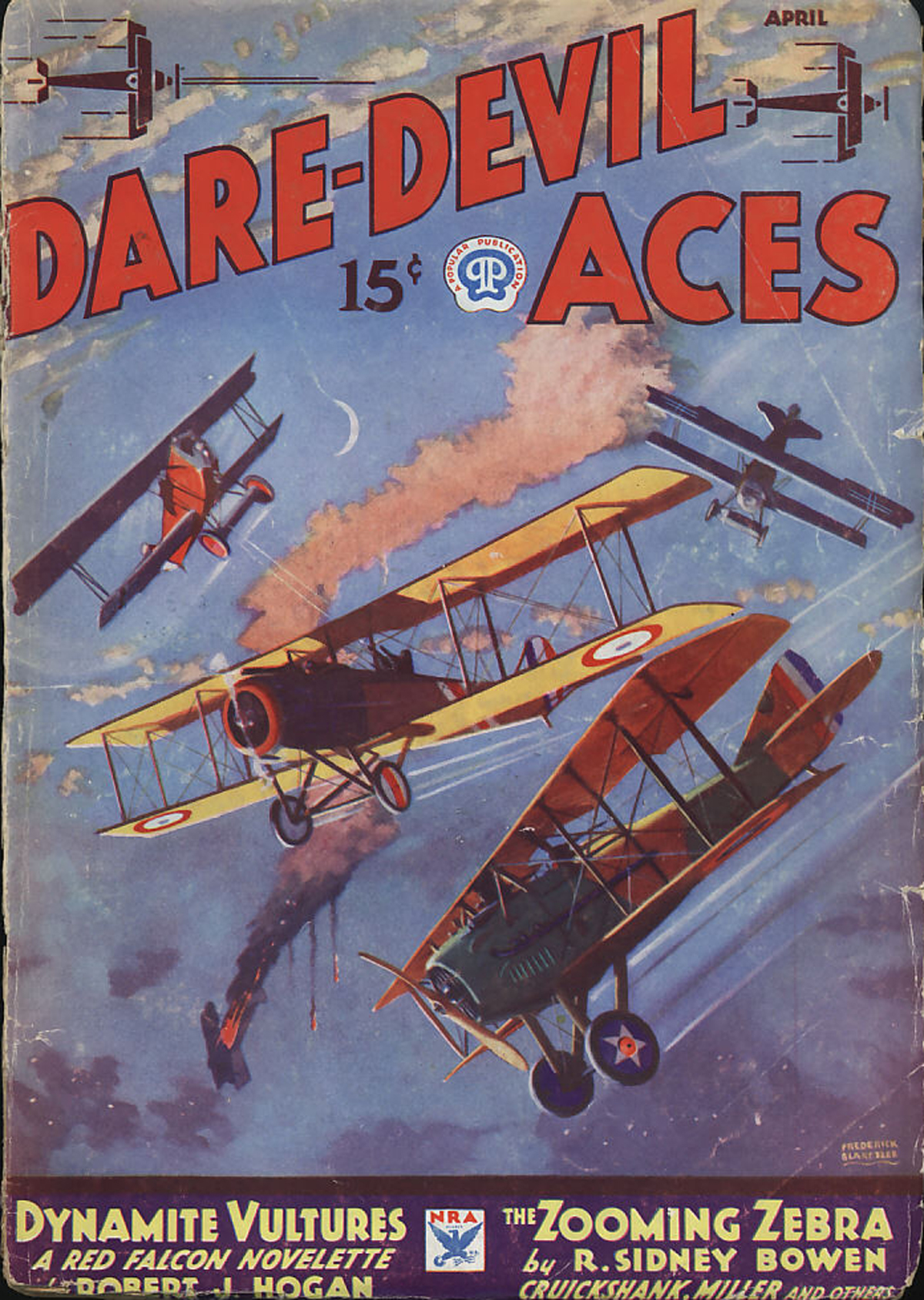
th_DDA_3404SUNSET. The lone Spad droned on, headed directly into the blazing rays of a dying sun that flushed the western skies with crimson. A Yank pilot sat in the Spad’s tiny “office,” his back to Germany, his two hour evening patrol over. From time to time he turned and searched the sky for enemy ships. He had nearly reached the lines when he saw them—four black specks, one larger than the others, all spinning about in crazy gyrations.

He snatched for binoculars. Three Fokker D-7’s were ganging a French Salmson. One, a blue Fokker, was just dropping on the Salmson’s tail. Spandaus flamed. Twin Lewises flashed in the sun. The Fokker seemed to shudder. The motor belched a billowy sheet of livid flame, then, falling into a right-hand spin, the Boche plane blazed its final trail across the sky like a fiery comet.

Instantly the two remaining Fokkers caught the Salmson in a deadly cross-fire. That was enough for the Yank. He stood the Spad on its prop, spun around and roared toward the fight.

A blue Fokker swelled in his ring-sight. He estimated the distance. Two hundred yards, one hundred yards. He reached for the trips. But just as his fingers tightened on the stick a red ship appeared like magic at his right. Spandaus steel smashed into his motor. The Hisso ground to a stop with a grating of metal parts.

Numb terror gripped the Yank’s heart. Engine dead, he was cold meat for those Boches. The red ship had looped upward, probably intending to swoop in a death-dealing dive; and from the corner of his eye the Yank could see the blue Fokker swinging in on his tail. He began gliding earthward.

As he flashed past the Salmson, he glanced up—and gasped. For the French observer had aimed his guns and was riddling the belly of the red Fokker with lead. The Boche ship hung for a moment in the sky, almost motionless—then it began to fall in a series of crazy side-slips, pilot fighting the controls.

But the blue Fokker was fast on the Spad’s tail now, raking the crippled ship with burst after burst. The Yank felt the tiny shocks of slugs smash up the camel-back toward the fuselage. Grimly he turned to face the final burst. As he did so the Salmson whipped around in a vertical bank not fifty yards away. Again twin Lewises flamed; feathery tracers impaled the blue Fokker’s cockpit. The Boche pilot slumped forward. His ship plunged down, guns still yammering, a dead hand clutching the trips.

Breathing a sigh of heartfelt relief, the Yank eased the stick and sought a place to set down. There wasn’t much time to choose. Two miles inside the German lines, with 500 feet altitude and a dead stick, it was pretty much of a hit and miss proposition.

A clearing showed ahead. He landed in it, jumped out and touched a match to the ship just as a squad of Germans rushed into the open, waving their rifles. But before they could reach him the Salmson came hurtling over the trees, Vickers snarling. The Boches faltered and broke, running for cover. The Salmson banked, bouncing past the Yank, who ran after it. Bullets pinged around his head but he flung himself on the wing.

A few minutes later on the tarmac of his own drome, he gripped the French pilot’s hand in a gesture that expressed his thanks more eloquently than words.

The Story Behind The Cover
“The Yellow Comet: The Story Behind The Cover” by Eliot Todd (April 1934)

Check back again. We will be presenting more Stories behind the Covers.

“Hell On Wings” by Frederick Blakeslee

Link - Posted by David on June 1, 2015 @ 6:00 am in

Frederick Blakeslee painted all the covers for the entire run of Dare-Devil Aces. And each of those covers had a story behind it. . . .

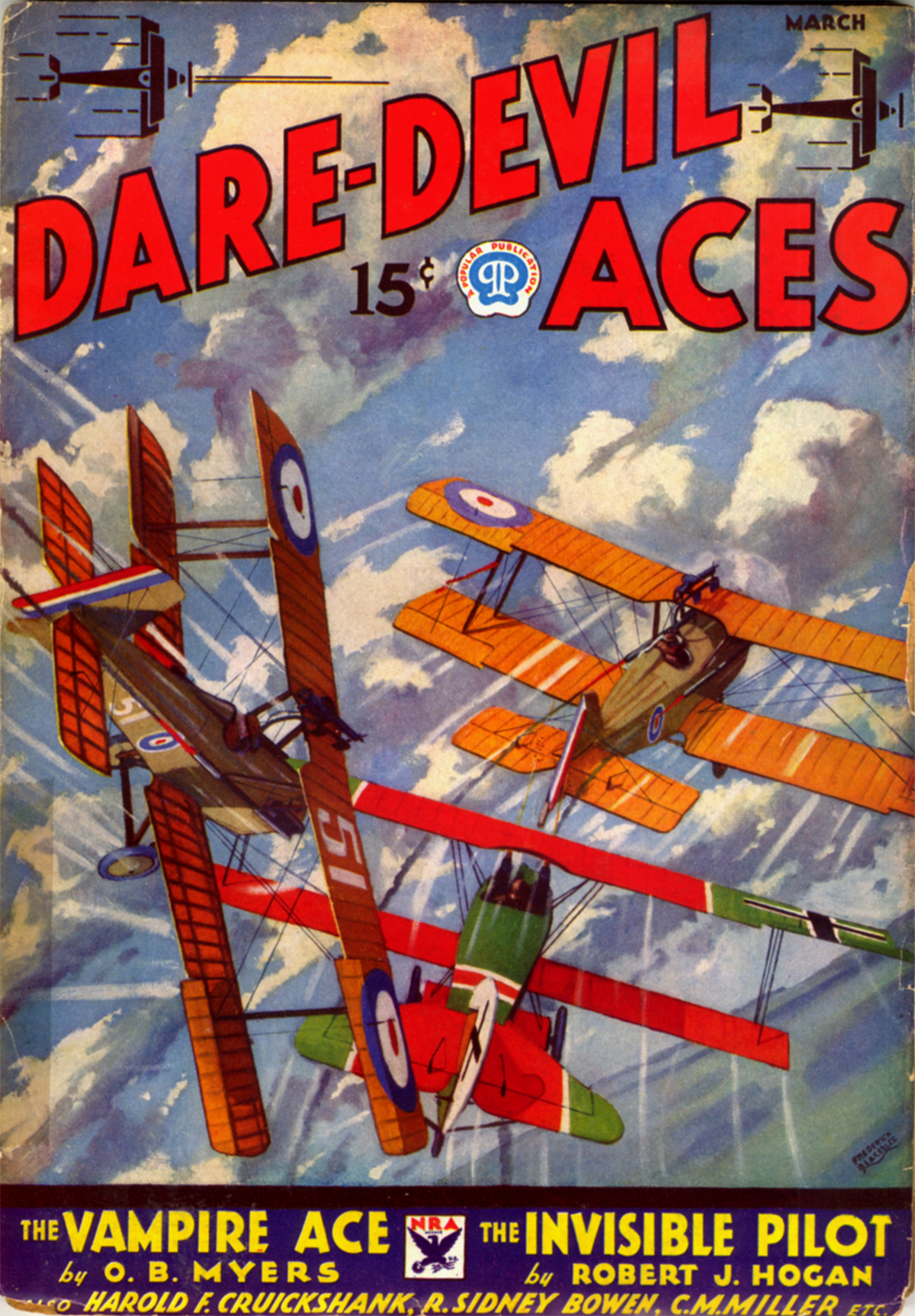
th_DDA_3403THE cover this month shows an S.E.5 diving on the tail of a Fokker which is on the tail of another S.E. A split second later—

Early in 1918 there appeared at a British squadron a group of replacements, among them a youngster whom we shall call Jones. After several practice flights near the lines, Jones eventually took his place in a formation that was out for real trouble. As they crossed the Front, archie was particularly active and very accurate. Shells burst close to the formation, too close for comfort, and Jones proceeded to zigzag madly. The patrol leader turned about to pick him up, but Jones was headed for home at full speed.

When the patrol returned an hour later, the leader proceeded to read the riot act to Jones. He was told that it was a pilot’s duty to keep formation, not only for his own sake, but for the sake of the rest of the flight. If the patrol got into a scrap, one machine missing would be serious— perhaps fatal. He was also told what became of stragglers, who were the Boche’s favorite dish. He was threatened with all manner of unpleasant things if he broke formation again. The lad promised to do his best.

That same day he was again a member of the flight. He kept formation despite archie—which was not as severe as earlier—and completed the patrol.

The next day, however, when archie plastered the sky a little more vigorously, Jones again broke formation and sped for home. This time the lack of one ship missing had serious consequences for the flight. They ran into seven Boches and the battle raged for half an hour. When the flight drew off for home, one of their number had gone to the happy hunting ground.

The straffing Jones received from the entire squadron is history. After long deliberation, the youngster was given one last chance to save himself from disgrace.

The flight left the field with Jones the next day. He had been moved in position to give him confidence and he stayed in place during the usual archie. Some half hour later the flight leader saw several Pfalz scouts 8,000 feet below. After a look around he gave the signal and down they went, Jones with them. During the fight two of the Germans were shot down, one in flames.

Them from above dove three Fokkers. One of these got on the tail of the flight leader, and before he realized what had happened he received a burst of Boche lead that put his Vickers out of action. He put his plane through every maneuver he could think of—and some he didn’t think of—but one of the Fokkers always clung to his tail.

There was nothing he could do but spin down and try to hedge hop home.

Down he went in a spin. At fifty feet he flattened out and with throttle wide open, streaked for home. But he was not alone. The Fokker still rode his tail, pumping steel into his S.E.

Nothing, apparently, could save the Yank. His Vickers were out of action and his Lewis drum was empty. Gas was getting low, also. As he turned, a burst went through the fairing back of his head just missing his shoulder. In desperation he swung in a steep right turn. Just as the Fokker turned to follow, out of the sky hurtled an S.E. The flight leader recognized the number—Jones . . . .

—the S.E. crashed into the Fokker; the wreckage dove deep into the ground. And so Jones died, that a comrade might live.

The Story Behind The Cover
“Hell On Wings: The Story Behind The Cover” by Frederick M. Blakeslee (March 1934)

Check back again. We will be presenting more of Blakeslee’s Stories behind his cover illustrations.

“Good Haunting!” by Joe Archibald

Link - Posted by David on April 24, 2015 @ 6:00 am in

“Haw-w-w-w-w!” That sound can only mean one thing—that Bachelor of Artifice, Knight of Calamity and an alumnus of Doctor Merlin’s Camelot College for Conjurors is back to vex not only the Germans, but the Americans—the Ninth Pursuit Squadron in particular—as well. Yes it’s the marvel from Boonetown, Iowa himself—Lieutenant Phineas Pinkham!
Do you believe in ghosts? They asked that question of Major Garrity, and he said no, but he didn’t like ‘em. They asked Phineas Pinkham, and he said yes, and he liked ‘em. Here’s a ghost story guaranteed to make you laugh—not shudder.

“Parlez Voodoo!” by Joe Archibald

Link - Posted by David on March 27, 2015 @ 6:00 am in

“Haw-w-w-w-w!” You heard right! That marvel from Boonetown, Iowa is back! And if things aren’t rough enough for Major Rufus Garritty with Pinkham about—imagine the horror if there were two Pinkhams! Say it ain’t so!
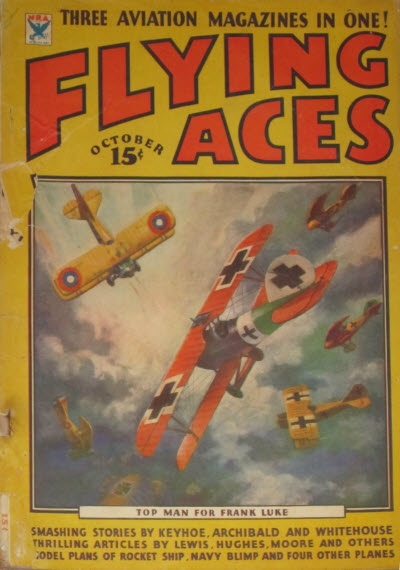
You’re going to laugh at what happens in this story—but Major Garrity and the boys of the Ninth Pursuit didn’t crack a smile. One Phineas Pinkham was enough for them—and two of him were—too much!

“Jinxed Joysticks” by Harold F. Cruickshank

Link - Posted by David on March 6, 2015 @ 6:00 am in

Today we a have a high-flying tale through war skies by Harold F. Cruickshank. Captain Bill Kelly tries to break the grip a jinx has on his best fighter ace by taking him on a trip straight down into Hell and back (hopefully). It’s “Jinxed Joysticks” from the March 1934 number of Flying Aces Magazine!

On any other day Tom Dillon would have thrilled at the yammer of those Spandaus—would have leaped to his guns as the pair of green-trimmed Fokkers dived by. But on this one day, when death came nearer than ever before, his hands froze on the Lewis grips—and he could not fire.

“Tattle Tailwind” by Joe Archibald

Link - Posted by David on February 27, 2015 @ 6:00 am in

Even the lowly angle worm, according to the old maxim, will turn and put up its dukes when sorely beset. The lowly worms of this story, of course, are the buzzards of Major Rufus Garrity’s Ninth Pursuit Squadron. Their tormenter, Lieutenant Phineas Pinkham, born on April Fool’s day, cradled in conjury and reared in raillery, perhaps had never heard about the deceptiveness of the proverbial worm. A worm had never kicked back at the amazing, freckle-faced, buck-toothed pilot from Boonetown when he was attaching it to the end of a fishhook. Nevertheless, Phineas should have known that he who lives by the sword will sooner or later get a taste of cutlery.
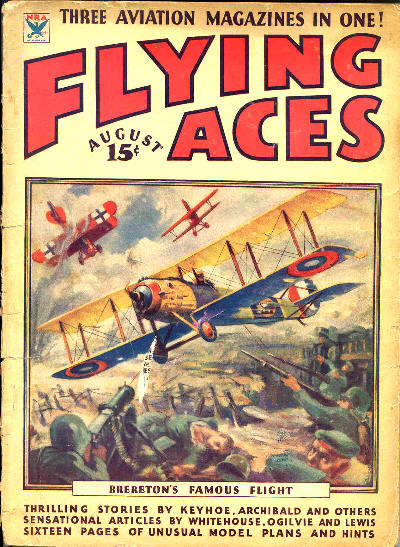
Major Garrity had chased Phineas off the drome. The Royal Flying Corps buzzards had sworn a vendetta against him. And over in Germany, the wily Rittmeister von Schnoutz was scheming. Aside from these, Phineas didn’t have an enemy in the world!

“Intelligence Pest” by Joe Archibald

Link - Posted by David on January 30, 2015 @ 6:00 am in

“Haw-w-w-w-w!” That sound can only mean one thing—that Bachelor of Artifice, Knight of Calamity and an alumnus of Doctor Merlin’s Camelot College for Conjurors is back to vex not only the Germans, but the Americans—the Ninth Pursuit Squadron in particular—as well. Yes it’s the marvel from Boonetown, Iowa himself—Lieutenant Phineas Pinkham!

Phineas Pinkham was so pleased with his particular prisoner that he even offered him a cigar that wasn’t loaded. Yes, they call that fraternizing with the enemy!

« Previous PageNext Page »