Looking to buy? See our books on amazon.com Get Reading Now! Age of Aces Presents - free pulp PDFs

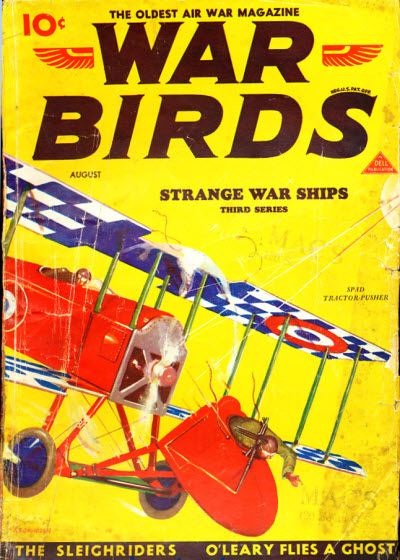
“Ginsberg’s War: Pfalz Alarm” by Robert J. Hogan

Link - Posted by David on December 22, 2017 @ 6:00 am in

    “Geeve a look,” he chirped. “I’m here, already. Abe Ginsberg’s de name.”

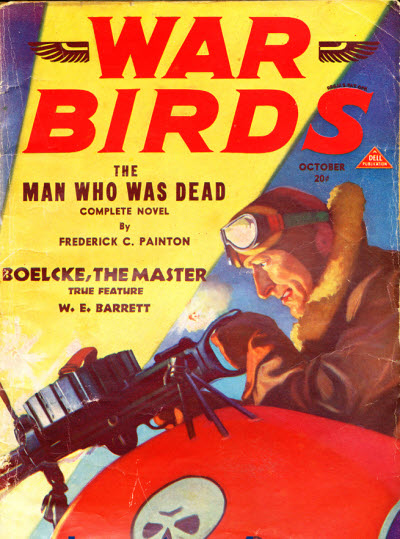
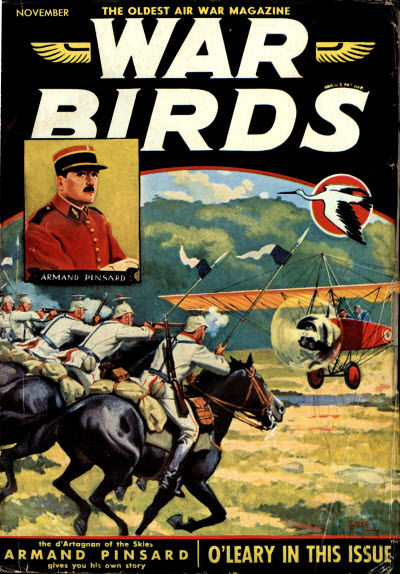
A HUNDRED years ago this month, the United States declared war on the Austro-Hungarian Empire. To mark the occasion, we’re posting Robert J. Hogan’s series of Abe Ginsberg stories that ran in the pages or War Birds magazine from 1932-1933. Although Ginsberg’s always first to stand up and volunteer, he’s often overlooked due to his short stature. This time he’s excluded from the mission as the French want to pin a medal on his chest. A muddy ride, a drunken celebration, and a dark hanger all lead to Ginsberg finding himself behind enemy lines attacking the Boche defenses from the inside!

Abe Ginsberg knew a bargain when he saw one. When it turned out to be a Pfalz alarm, he had to ask them “Catch On?”

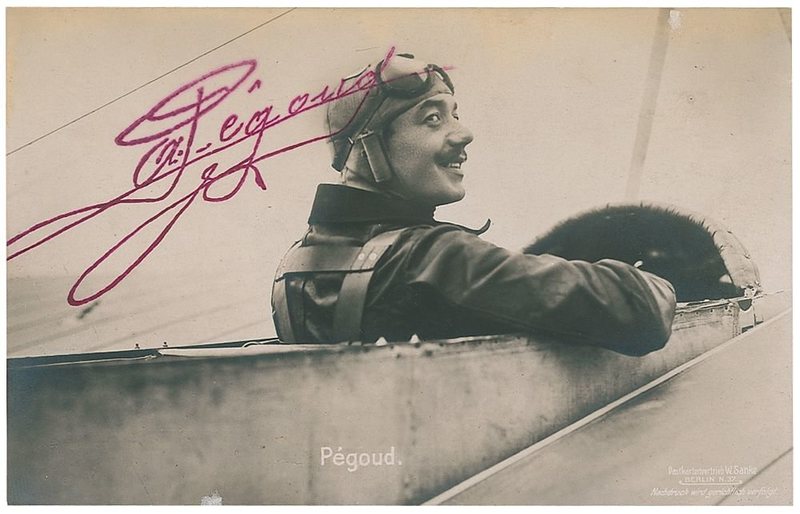
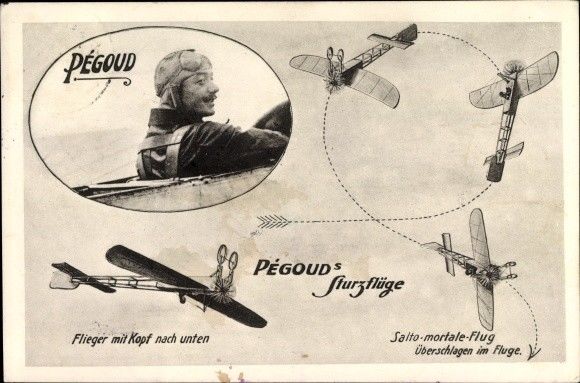
“Lives of the Aces in Pictures – Part 45: Adolph Pegoud” by Eugene Frandzen

Link - Posted by David on December 20, 2017 @ 6:00 am in

Starting in the May 1932 issue of Flying Aces and running almost 4 years, Eugene Frandzen’s “Lives of the Aces in Pictures” was a staple of the magazine. Each month Frandzen would feature a different Ace that rose to fame during the Great War. This time around we have one of the great French Aces—Lt. Adolphe Pegoud!

Adolphe Célestin Pégoud was born 13 June 1889 in Montferrat, France.[1] Pégoud served in the French Army from 1907 to 1913. Discharged on 13 February 1913, he immediately began flying, and earned his pilot’s certificate 1 March 1913.

Pegoud was in the aviation service in Morocco before the war—and already world famous. Pegoud’s renown came from his feat of being the first Frenchman to loop the loop. He was also first to attempt a drop from a plane by parachute!

At the outbreak of war, Pegoud immediately joined the gallant band of experienced airmen who undertook to get information for their army by use of planes. Frequently sent on dangerous reconnaissance trip far back of the German lines—he gathered data that was invaluable tot the harassed French ground forces in the fall of 1914.

Pegoud is credited with six victories and was awarded the Knight of the Legion d’Honneur, Medaille Militaire, and Croiux de Guerre!

On 31 August 1915, Pégoud was shot down and killed by one of his pre-war German students, Unteroffizier Walter Kandulski, while intercepting a German reconnaissance aircraft. He was 26 years old.

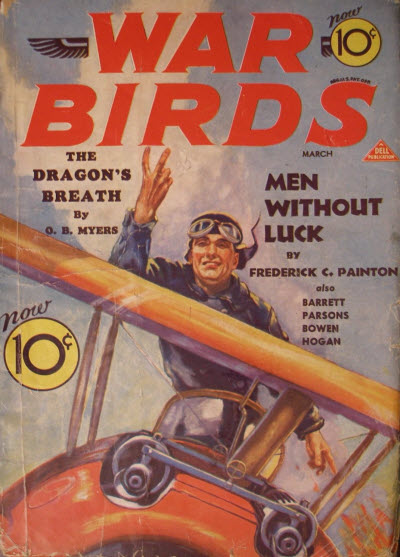
“Ginsberg’s War: Excess Braggage” by Robert J. Hogan

Link - Posted by David on December 15, 2017 @ 6:00 am in

    “Geeve a look,” he chirped. “I’m here, already. Abe Ginsberg’s de name.”

A HUNDRED years ago, the United States declared war on the Austro-Hungarian Empire. To mark the occasion, we’re posting Robert J. Hogan’s series of Abe Ginsberg stories that ran in the pages or War Birds magazine from 1932-1933.

Lieutenant Abe Ginsberg was very proud. He wasn’t very tall, but he made the most of his stature as he squared his narrow shoulders. His small feet and spindling legs were encased in the best pair of cut-rate boots careful money could buy. The new whipcord officer’s uniform hung loosely about him, not a perfect fit, but what of it? Hadn’t Abe saved almost a hundred francs on that suit after an hour’s haggling?

They told Abe to brag of the might of his wings and it would win him the C.O.’s job. Abe bragged. But what it won him was something else again.

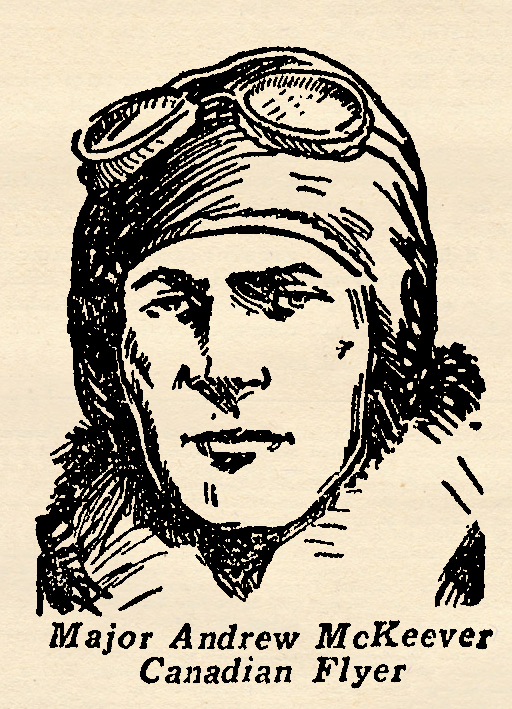
My Most Thrilling Sky Fight: Major Andrew McKeever

Link - Posted by David on December 13, 2017 @ 6:00 am in

AMIDST all the great pulp thrills and features in Sky Fighters, they ran a true story feature collected by Ace Williams wherein famous War Aces would tell actual true accounts of thrilling moments in their fighting lives! This time we have Canadian Air Ace Major Andrew McKeever!

Andrew Edward McKeever was one of the many daring young sky fighters that came from Canada to add fame and lustre to the deeds and exploits of the Royal Air Force, He put in almost a full year in the infantry before he was transferred for flying training. He joined the R.F.C. in December, 1916, was commissioned a lieutenant and sent over to the 11th Observation Squadron in France on May 16th, 1917.

As a two-seater fighter he was without a peer. Beginning his career of victories just as he turned 19, this brilliant young man brought down his first enemy aircraft a month after he went to the front. When the war ended he was credited with 30 official victories, more than any other two-seater pilot in any other army.

He won the British D.S.O. and M.C, and the French conferred upon him the Croix de Guerre. He survived the war without ever receiving so much as a scratch in sky battles, only to be killed in an automobile accident in his home town on Christmas Day in 1918. The story below is his own account of a battle with 9 Huns 60 miles behind the enemy lines.


TWO HUNS WITH ONE BURST

by Major Andrew McKeever • Sky Fighters, February 1936

IT WAS soupy weather when my observer and I took off. There was a drizzling rain and the clouds over the trenches were almost on the ground. But H.Q. had ordered a picture of an ammunition dump 60 miles behind the lines. I volunteered to get it, and took advantage of the soupy weather in sneaking into Hunland. All the way in we saw no Huns. And we saw none at the dump. I flew above the clouds all the way by compass, and nearing what I thought should be my destination I dropped down through a hole in the clouds to get my picture. Odd as it sounds, I was right over the ammunition dump. Flying without sight of the ground I had hit the target of my flight right on the bull’s-eye.

The pictures were easy to get. My observer snapped them at 500 feet altitude, then we turned back for the long trip home, only to be met by 9 Huns, who had apparently been waiting for us. Two of them were painted a brilliant red. The other seven were black. They lost no time attacking when we turned for our own lines.

“Shall I run for it, or shall we try to fight them off?” I yelled back through the phones at my observer. “They’ve got the speed on us,” he shot back. “We can’t run. We have got to fight!”

His own guns were stuttering even before he finished, and tracer from the leading Hun attacker, a red Pfalz, was clipping through my upper center section. I lifted the Bristol’s nose and aimed for the Hun’s belly as he shot over me. I had time for just one short burst. But it was enough for that Pfalz. It went over and nosed into the ground, bursting in flames when it crashed. Gilbert, my observer, kept the Huns from sitting on my tail as I split-aired and dove for the other red Pfalz. A black Fokker cut across behind the Pfalz just as I fired. The Pfalz pilot wilted if his seat. My burst almost tore his head off. His ship went down, spinning erratically.

But the strangest thing was that the Fokker behind him fell apart in the sky at the same instant. One wing came off and fluttered down slowly. The fuselage and other wing sank like a plummet. That single burst of mine had passed through the Pfalz pilot’s head and sheared the Fokker’s wing off.

Gilbert, meanwhile had got one of the Fokkers, trying to attack from the rear. But two more pounced in on him, while I dived for one below me. There was terrific clatter and I looked over my shoulder toward the back pit. I couldn’t see Gilbert. I turned back again to get my sights on the Fokker and spray out a burst. It never came out of the nose dive it was in, just hurled on into the ground. I looked back again, and was relieved to see Gilbert standing in the back pit. But he was pointing at his Lewis guns. They were useless. A Spandau burst had wrecked them completely.

I swung around again and went for a persistent Fokker who was trying to get at me from below. I got my sights on him and pressed the trips. But it was no go! My guns didn’t answer. I reached up to clear what I thought was a jam. But it was worse than a jam. The whole breech had been shot away. My own gun had been rendered useless while I was staring at Gilbert’s.

We couldn’t fight any longer, so I ran for it. We hedge hopped in and out of the clouds all the 60 miles back, with those four Fokkers hi-tailing after us. But the clouds served in good stead. The Fokkers followed me right to the drome, and didn’t leave until I sat down.

Death whispered in our ears all the way back, but my old Bristol had just enough speed to keep one jump ahead of the grim spectre. It was my hardest and longest fight . . . and closest shave. I don’t want any more like it. And for once Gilbert agreed with me.

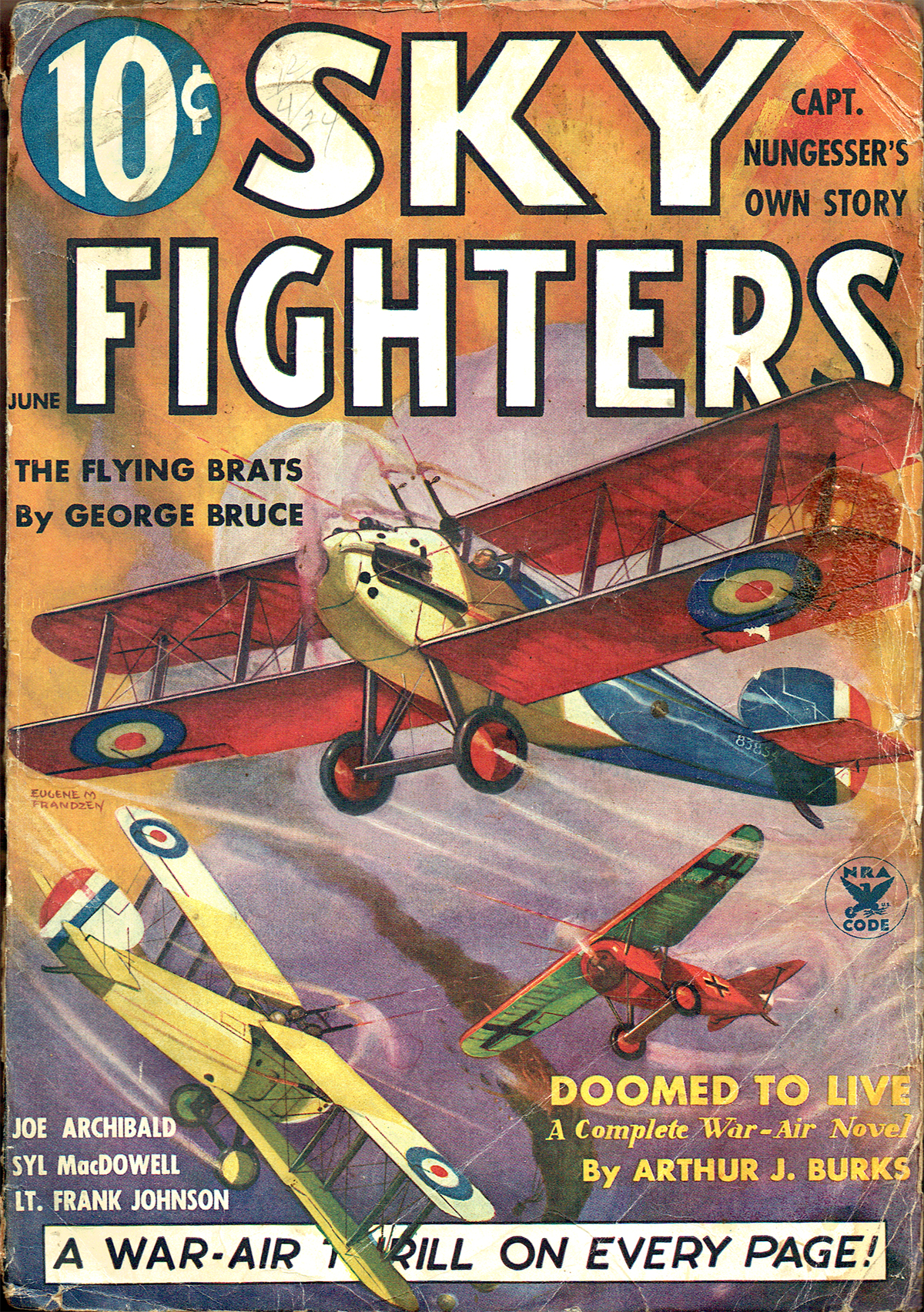
“Sky Fighters, June 1935″ by Eugene M. Frandzen

Link - Posted by David on December 11, 2017 @ 6:00 am in

Eugene M. Frandzen painted the covers of Sky Fighters from its first issue in 1932 until he moved on from the pulps in 1939. At this point in the run, the covers were about the planes featured on the cover more than the story depicted. For the June 1935 cover, Mr. Frandzen features the Sopwith Dolphin and the Fokker D VIII!

The Ships on the Cover

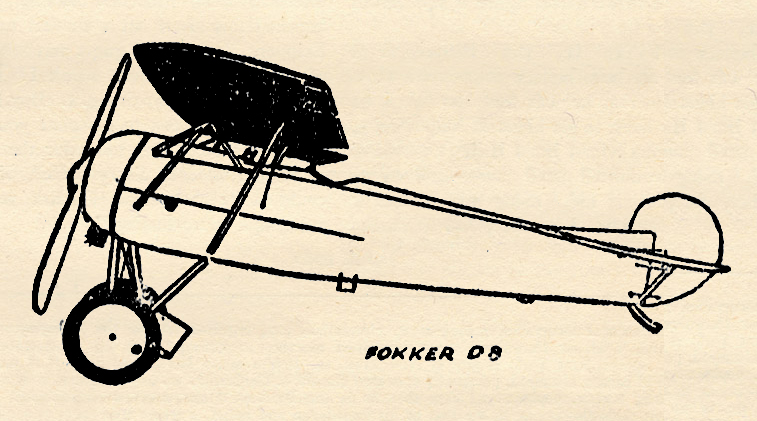
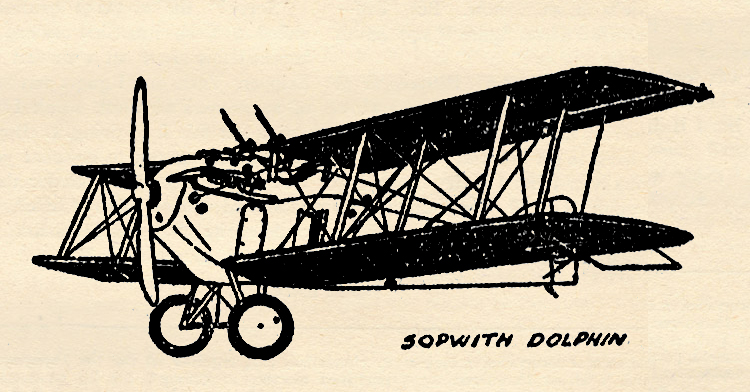
TWO of the last ships to th_SF_3506 get into the air to swap lead in the World War were the Fokker D8 and the Sopwith Dolphin. The Dolphin had four exposed machine-guns, two Vickers shooting through the propeller arc and two Lewis guns shooting over the top of the arc at 45 degrees. The Dolphin’s pilot had good visibility with his top wing cut away and his office parked directly beneath this opening. His vision depended only on how far he could swivel his neck without putting it out of joint.

The Fokker D8, also known as the “Flying Razor,” was Fokker’s last contribution to Germany’s air fleet. He built it around an Oberursel motor because he could not depend on delivery of the Mercedes motors which he had used in his famous D7.

These Oberursel engines had been kicking around for months before Fokker finally in desperation figuratively jacked them up and built planes around them. Not many of these planes got to the front, but those that did, were used to good advantage. Udet, the famous German Ace flew the D8, and liked it. It was not as fast as Fokker would have liked because of the limited power of the rotary in its nose. But its ability to maneuver like a streak of greased lightning got it places where it could do things quicker than some planes with greater power which answered to their controls sluggishly.

Many Balloon Victories

Balloon busting was not confined to such sharpshooters as our own Frank Luke or Belgium’s Willy Coppens. Scattered through the official records of the Allies are scores of balloon victories chalked up to the credit of its flyers. Each of those downed bags represented a drain on the Kaiser’s money bags up to as high as $100,000. Therefore, the balloon falling in flames put a dent equal to from three to six war planes in the German finances.

As the Germans entered the last year of the war their supplies for making their kite balloons, or drachens, was at a premium. Where, in the early war stages, a half dozen of the cumbersome observation bags could be seen strung along four to six miles behind their lines, now only an occasional balloon floated.

“Blind the German’s observation,” was the terse order issued to all Allied armies.

By telephone, wireless, and despatches, this command raced along the lines. Long range guns poured streams of whistling shells into the skies. Their hits were few and far between. The ammunition wasted could have flattened mountains. The gunners gave up and watched tiny specks far up in the skies darting past, fading into the smoky war haze and disappearing over German territory.

Racing Through the Blue

Spads, Nieuports, Bristols, Moranes, Sop Camels, S.E.5’s raced through the heavens. Then the new Sopwith Dolphins flashed their black-staggered wings against an orange sky. Hisso motors yanked them toward a mountainous section where a German balloon had been floating unharmed for months. The massive gas bag was swaying swiftly down to its retreat between rocky crags as the Sopwith tipped their stubby noses down and blazed incendiaries into it. Smoke, then flame belched forth as the porcine mass writhed, collapsed and sank.

Two small monoplanes, one climbing rapidly. Another, diving, bracketed the Dolphins. Incendiary bullets were in the Sops’ Vickers belts, bullets that are outlawed for warfare against man. Down tipped the nose of one Dolphin, up went the prop of the other. Lewis guns bucked in their mounts, streams of orthodox bullets connected the enemy plane with the Dolphins. Two black-crossed monoplanes, “Flying Razors,” staggered in their flight. Blunted and dulled, they fluttered like discarded razor blades pitched from a roof, down into the purple haze of oblivion.

The Ships on The Cover
Sky Fighters, June 1935 by Eugene M. Frandzen
(The Ships on The Cover Page)

Next time, Mr. Frandzen features the Spad 22 and 13 C1!

“Ginsberg’s War: Crash on Delivery” by Robert J. Hogan

Link - Posted by David on December 7, 2017 @ 6:00 am in

A HUNDRED years ago today, the United States declared war on the Austro-Hungarian Empire. To mark the occasion, we will be posting Robert J. Hogan’s Abe Ginsberg stories that ran in the pages or War Birds magazine from 1932-1933.

    “Geeve a look,” he chirped. “I’m here, already. Abe Ginsberg’s de name.”

Lieutenant Abraham Ginsberg was small and slim-shouldered. His eyes twinkled over a Roman nose and from under heavy, black brows. His head was crowned with curly hair of the same hue. His face was like leather, tanned by wind and sun and blasting prop wash of many flights. His uniform, ill-fitting and sagging at the knees, was in striking contrast to the finely tailored outfits of the favored sons of the Seventy-sixth. A long, leathery coat, smeared with grease and oil and stained about a hole at the shoulder, where a Spandau slug had necessitated a vacation for a time, hung perilously from his slim shoulders; it was held together at the front with a huge safety pin, that once had graced the blanket of a horse in a wind storm.

Abe had medals on his chest and a yen in his heart to fly with a high-hat outfit. When he found they didn’t want him he invented the slogan “Crash on Delivery.”

My Most Thrilling Sky Fight: Lieutenant Joe Wehner

Link - Posted by David on November 29, 2017 @ 6:00 am in

AMIDST all the great pulp thrills and features in Sky Fighters, they ran a true story feature collected by Ace Williams wherein famous War Aces would tell actual true accounts of thrilling moments in their fighting lives! This time we have Frank Luke’s tail gunner, Lieutenant Joe Wehner!

Lieutenant Frank Luke was the most daring sky fighter in the American Air Service. But it is hard to say whether he would have established the record he did without the aid of Joe Wehner, his constant and steadfast companion and buddy in the 27th Squadron. He was Luke’s alter ego.
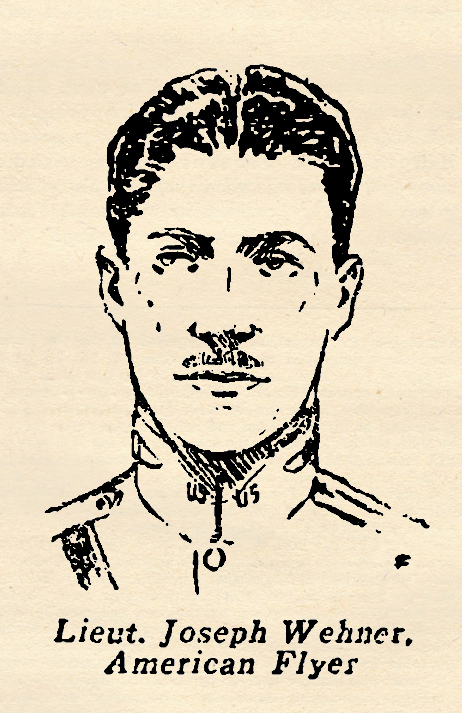
When war was declared by the United States, Joe Wehner hitch-hiked his way from Boston, Massachusetts to Kelly Field, Texas, to join the flying service. Wehner was finally dropped from his squadron when it left Kelly for overseas because he was suspected of being a German spy. He managed, however, to get reinstated at the point of debarkation. His fellow officers, however, never ceased to look upon him with suspicion. That is, all except Luke. Luke stood up for Wehner and this made him an outcast in the 27th until he began to compile his flaming and meteoric record. Flying with Luke on those record-making flights was Joe Wehner, and Luke himself admitted after Wehner was killed in action, that if it hadn’t been for Joe Wehner, who served as his protection when he went Drachen hunting, he doubted if he would have been able to down the number of Drachens credited to him.

Wehner shot down three enemy planes while flying this rear guard duty for Luke. As a protection flyer, there was none better in the American Air Service than Joe Wehner.

From on of Wehner’s letters to his boyhood friend in Boston, the following account is taken.


STALKING THE DRACHEN

by Lieutenant Joseph Wehner • Sky Fighters, January 1936

FRANK and I have developed a specialty. We are sausage hunters. Sausages, you know, are anchored observation balloons. The Boche call them Drachens. One day when I was flying rear guard for Luke, he shot down two of them within two min-

In addition to the Drachens he got two Bocke planes, and I was lucky enough to down one myself. In one swift, hectic fight, we accounted for five Boche, and we were outnumbered three to one. But Luke never takes account of odds.

We went out just at twilight, saw two Hun Drachens straining against their cables and weaving in the wind near Vieux. Frank held up his arm and signaled me that he was going down to get them, one after the other. I saw a patrol of Boche Fokkers further back across the lines, so I began to climb for ceiling as Frank started down toward the balloons. I aimed to get between him and the Fokkers to keep them off his tail when he started firing at the balloons.

Frank got the first Drachen before I could get between him and the Boche. He split-aired through the enfilade of machine-gun and anti-aircraft fire, and made a bee line for the second Drachen less than a kilometer distant. He scooted along at terrific speed not more than a hundred feet off the ground. But the Fokkers having height streaked even faster for him. There was a full Staffel of them. I piqued to head them off. The Staffel separated then into three flights. One went to my right, the other to my left and the center flight came at me hell for leather.

I picked the first Fokker and gave him the works. My aim was true. It wobbled for an instant. Then the pilot slumped down in the pit, and the Fokker slid off in a spin. I was watching it fall when a clatter of leaden hail rattled through my upper wing tank. The gas began pouring out in a blinding spray. Then black smoke enveloped me. For an instant I thought my Spad was aflame. The fumes were choking. But the smoke instantly cleared, and I realized it was the smoke of the second Drachen which I had winged through. Luke had made swift work of that sausage and was going round and round now with a Boche, while two more were darting in on him from different angles above.

I went down for the Boche on Frank’s tail, and we went at it hot and heavy. The whole sky seemed to be a kaleidoscopic whirl of diving, zooming, shooting black-crossed planes. Then one of the black-crossed ships burst into flame. Luke had ridden it almost to earth, firing with both guns. Zooming up when it crashed, he made for another Hun’s blind belly, and brought it down before the pilot knew what had happened.

The wind had drifted us across our own lines now, and the Boche Staffel leader called it enough, I guess, for all of a sudden they beat it for their own lines. Frank chased them until he ran out of ammo, and I coursed along on top of him. But we got in no more licks.

Next Time: MAJOR ANDREW McKEEVER

“Sky Fighters, May 1935″ by Eugene M. Frandzen

Link - Posted by David on November 27, 2017 @ 6:00 am in

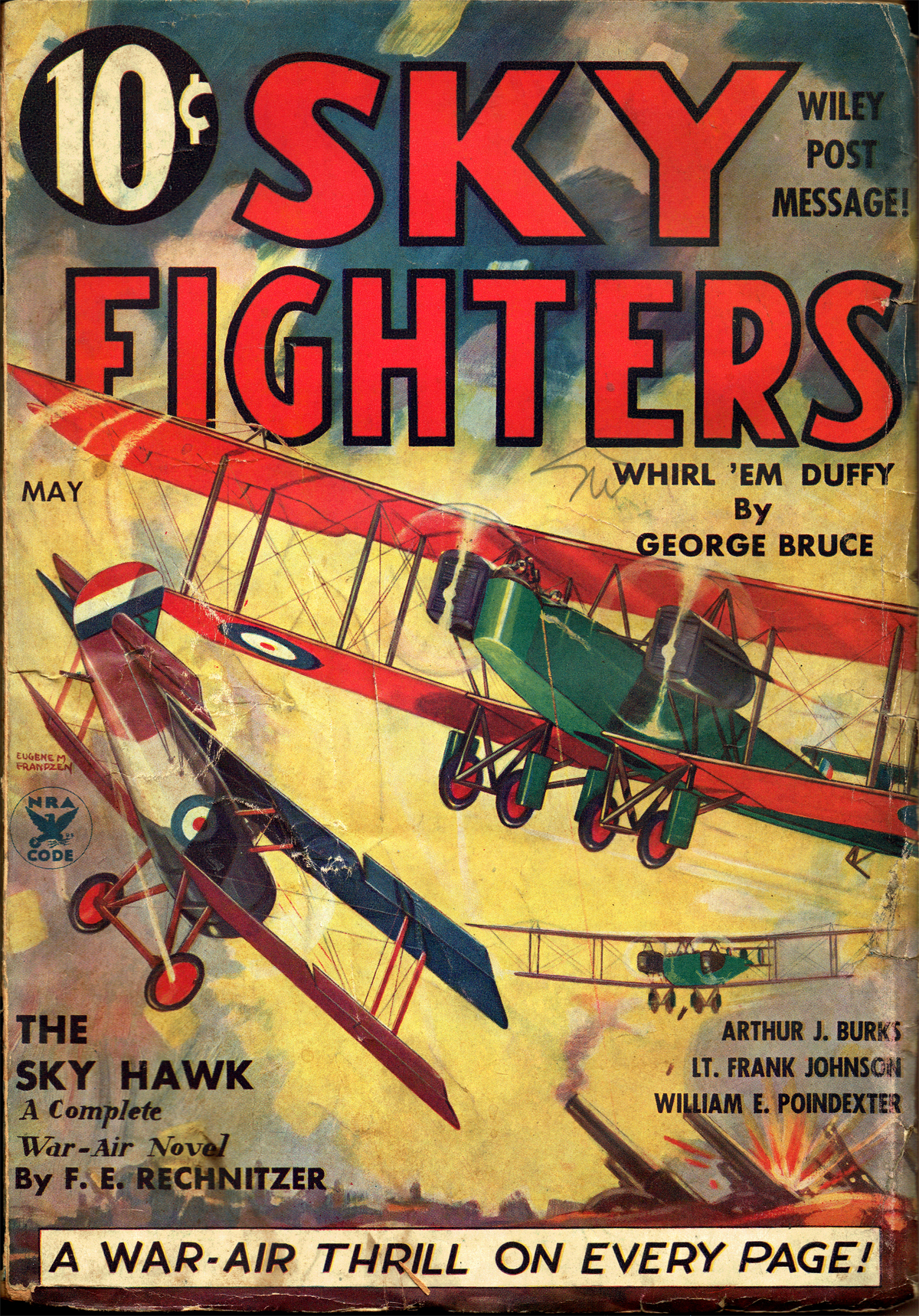
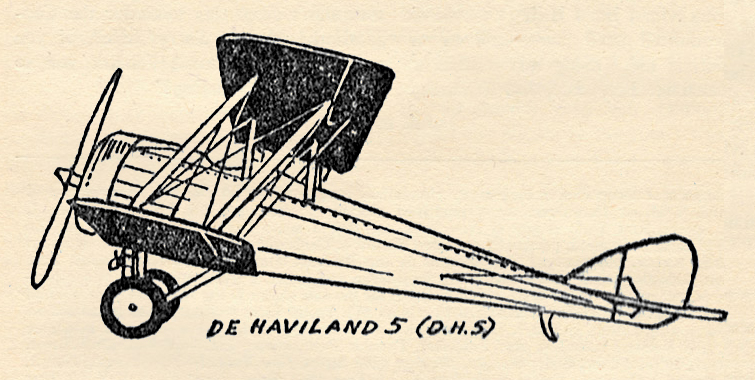
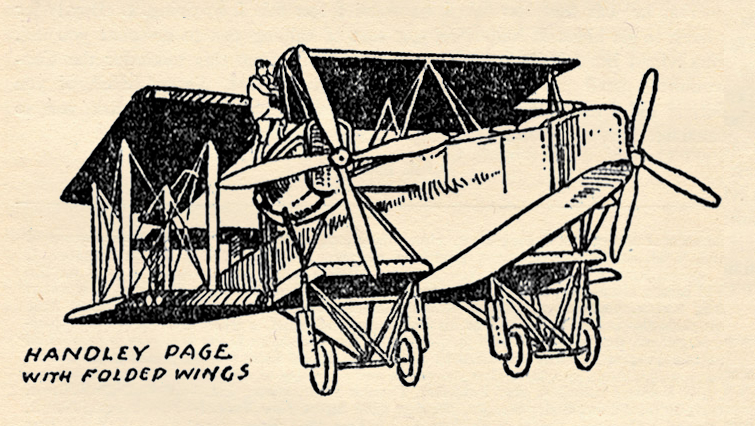
Eugene M. Frandzen painted the covers of Sky Fighters from its first issue in 1932 until he moved on from the pulps in 1939. At this point in the run, the covers were about the planes featured on the cover more than the story depicted. On the May 1935 cover, a de Haviland 5 protects a couple Handley Page 0/400s over a Boche battery!

The Ships on the Cover

THE Handley Page 0/400 twin-engined th_SF_3505bomber pictured on the cover was the most publicized bomber produced by Great Britain during the World War. This company produced a larger four-engined job, the V/1500, with a wing span of 126 feet toward the end of hostilities. It was built to raid distant German cities: Berlin was to be the first one on which the British steel-cased calling cards were to drop.

The 0/400 was a sturdy, dependable old stick and wire job with a top speed about 98 miles per hour. The criss-cross bracing of the under-carriage held the wheels sturdily enough so that the 100 ft. ship could be set down pretty roughly without the landing gear folding and the ship rolling up in a ball. The wings folded back along the sides of the fuselage to conserve space when the ship was hangared. The standard engine equipment was two Rolls Royce Eagle 8s, but Liberties, Sunbeams, Fiats, etc., could be used as alternatives.

But There Was No Eclipse

It is interesting to note that the United States was going to manufacture this bomber, using Liberty motors, to send over to the Yank aviators to use against the Germans. One optimistic orator in Washington proclaimed, “We will blanket the war skies with these huge bombers. We will have such great numbers flying at the Hun that the sun will be blotted out!” Well, there was no eclipse registered during the latter part of the war.

The D.H.5 is one of the long line of de Haviland war planes that are more or less familiar to most readers. The D.H.5’s 25 ft. wings were back-staggered to give the pilot a full vision forward and up. This trick wing arrangement cut down the efficiency of the plane but careful streamlining and reduction of head resistance brought the scout’s rating pretty well up on the right side of the ledger.

It could click off around 105 miles per hour with its 110 h.p. Le Rhone rotary motor whirling at top speed.

Blazing Vickers

The D.H.5 had spotted a German battery dug in the back of the boche lines throwing a barrage of shells toward the British lines. He tilted his ship down and blazed away with his Vickers. The German gun crews took cover for a few minutes and were back at their jobs as soon as the D.H. zoomed. This would not stop the Germans, the pilot realized, so he opened his throttle and tailed for a British bomber squadron’s hangars. The Germans wriggled their fingers at their noses and threw shells into the hot guns faster than ever.

A battery of “heavies” makes plenty of racket and plays havoc with the eardrums of the humans servicing its hungry maws, so it is not a miracle that allowed the tiny D.H. to lead his giant bombers to within striking distance of the Boche battery. The Germans’ first warning of danger was the high screech of whistling wires as the D.H. zipped past the slower bombers and flipped his tail over and up. Down he came with Vickers flaming. At the same moment the Handley Pages let loose a hail of heavy bombs. The enemy’s cannons were tossed into the air, twisted masses of useless steel. The gun crews disappeared in clouds of smoke and debris.

Opinions Differ

Back across the Allied lines the Tommies crawled out of dugouts and from behind sandbags, wiped the dust out of their eyes and went calmly about the business of pointing rifles and pulling triggers. Later they saw the big bombers lumbering overhead toward home.

“They say those airplanes are doing a bit of good now and then,” said one Tommy to another.

“Don’t you believe it,” replied his friend. “It’s us infantry wot’s winning this war!”

The Ships on The Cover
Sky Fighters, May 1935 by Eugene M. Frandzen
(The Ships on The Cover Page)

Next time, Mr. Frandzen features the Fokker D8 and Sopwith Dolphin!

“An Itch In Time” by Joe Archibald

Link - Posted by David on November 24, 2017 @ 6:00 am in

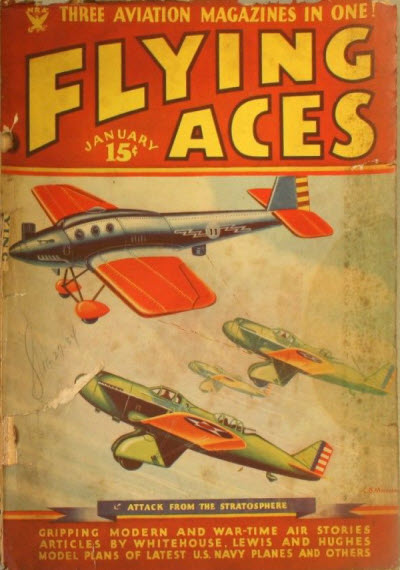
“HAW-W-W-W-W!” You heard right! That marvel from Boonetown, Iowa is back causing more trouble than he’s worth! That Knight of Calamity manages to find not only the Boche’s ammo train, but a former victim of the ol’ Pinkham charm from his hometown now glad to seek revenge! How can he stop the Boche ammo train, escape the butcher of Boonetown, and capture the Rittmeister von Schnoutz? He does it all with mirrors—Find out in “An Itch In Time” from the pages of the January 1935 Flying Aces.
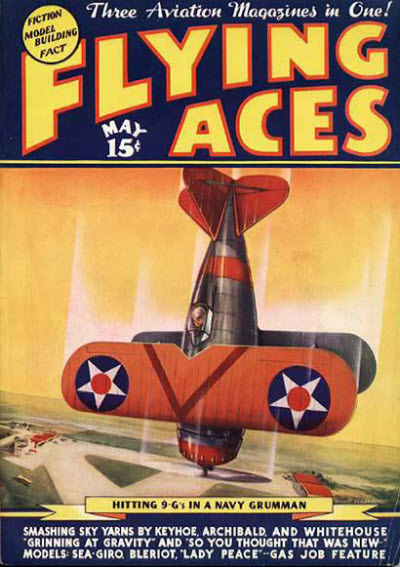
Phineas Pinkham turns palmist and predicts a dark fate for a certain major. But Phineas should have read his own palm first. His fate line would have showed him a bright future— bright like the bottom of a vat of tar!

Richard Knight in “Falcons from Nowhere” by Donald E. Keyhoe

Link - Posted by David on November 17, 2017 @ 6:00 am in

THE unstoppable Donald E. Keyhoe had a story in a majority of the issue of Flying Aces from his first in January 1930 until he returned to the Navy in 1942. Starting in August 1931, they were stories featuring the weird World War I stories of Philip Strange. But in November 1936, he began alternating these with sometime equally weird present day tales of espionage Ace Richard Knight—code name Agent Q. After an accident in the Great War, Knight developed the uncanny ability to see in the dark. Aided by his skirt-chasing partner Larry Doyle, Knights adventures ranged from your basic between the wars espionage to lost valley civilizations and dinosaurs. The mysterious Four Faces—a criminal cabal that seek to control all crime on the earth—has found a way to turn people to stone, which comes in handy while they continue to build their air fleet of stolen ships!
Through the growing twilight sped a powerful Northrop, and from its front pit peered Richard Knight. He saw no other ship in the sky; the secret of their mission was safe. But Richard Knight was unaware that an unseen hand was reaching through that descending pall to tear away an invisible veil—to loose upon him a hideous fate that had never before been faced by man. That fate was the ‘doom of stone’—and it had been streaming across the boundless wastes of eternity since the dawn of time.

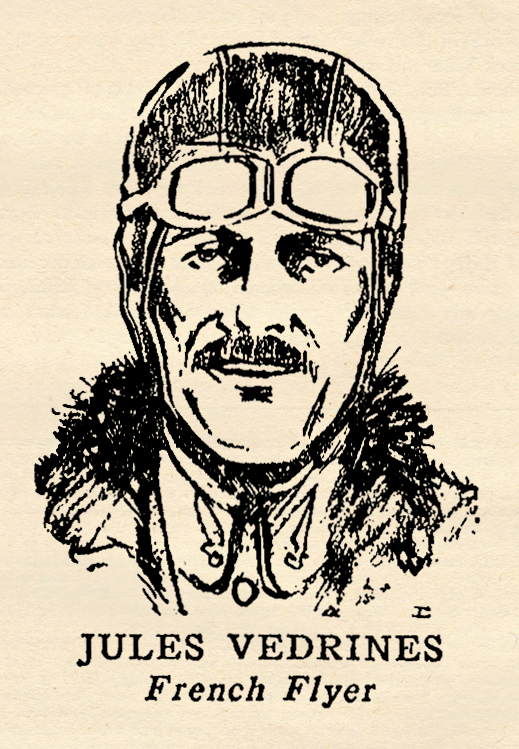
My Most Thrilling Sky Fight: Lieut. Jules Vedrines

Link - Posted by David on November 15, 2017 @ 6:00 am in

AMIDST all the great pulp thrills and features in Sky Fighters, they ran a true story feature collected by Ace Williams wherein famous War Aces would tell actual true accounts of thrilling moments in their fighting lives! This time we have French Flyer Lieutenant Jules Vedrines’ most thrilling sky fight!

In the year before the great war broke out Jules Vcdrines was the most famous flyer of France. He had twice won the Gordon Bennett speed trophy, and held both distance and altitude records. It was through his efforts that France wrested supremacy of the air from the United States and Great Britain. Along with Garros, Pegoud, Marechal, Le Blanc, Audemars, and other famous French flyers of his day, he enlisted in the French Flying Corps the day after war was declared.
The war was in its last stages before the nature of Vedrine’s work was revealed to his admirers. He had been engaged in doing special missions, and had established his reputation as being the Ace of Aces in that specialty, which consisted in leaving and picking up French spies behind the enemy lines. He received every decoration possible . . . but had to wait until the war’s end before he could bask in the glory of his achievements, for only then were his many honors divulged. The account below is from an interview with Jacques Mortane, great French war correspondent and flyer extraordinary himself.


SPECIAL AIR MISSIONS

by Lieut. Jules Vedrines • Sky Fighters, December 1935

THESE special missions are sometimes exciting. There was that time when I flew behind the enemy lines to pick up Sous-Lieutenant Huard. Three times before I had landed in this same meadow and picked up agents of the intelligence in full daylight. I thought our secret field was safe from German eyes. But I was to be surprised! I crossed the lines at a great altitude, over 6,000 meters. Then high over the meadow I cut the motor and sneaked down silently. I circled the meadow once at low altitude. Everything looked all right, so I volplaned in.

It was only when I got down to ten feet above the grass that I saw what the Germans had done. They intended to trap me. They had stretched wires across the meadow just high enough above the ground to make my avion nose over when the wheels touched earth. But I saw the wires just in time. I fed all essence to the motor and jerked the stick, zooming upwards.

At the same instant machine-guns hidden in the woods surrounding the meadow opened up at me at point blank range. Bullets splattered into my avion like hail from two sides, and German soldiers came from the woods firing rifles!

In another meadow several hundred yards away, I saw a man garbed in peasant attire running and waving his arms over his head. I looked close, saw that it was Huard waving me in to land on the next meadow. It appeared like certain suicide for both of us, but what was I to do? I cut off and nosed down. Bullets still hailed all around me, and I could see them kicking up patches of turf at Huard’s feet.

My wheels touched the meadow. Huard stumbled and fell on his face. When he struggled up, his leg folded beneath him and he fell again. He had been wounded. I shouted to Huard to grab the outer wing strut as I passed over him. He struggled up on his knees, reached out his hands. I could see his face. It was white and contorted with pain.

But he succeeded in grabbing the wing edge with one hand, and the forward strut with the other. I shot on the motor then and coursed along the ground to get away from the German bullets. Huard was dragging by the heels. A barb wire fence loomed ahead. I had to cut the motor. Before the avion stopped rolling, I leaped out and grabbed the strut Huard was holding. Together we swung the avion around in the opposite direction.

We would run into the fire again, I knew. But Huard only smiled when I mentioned that to him as I helped him in the rear seat. “C’est la guerre!” he replied lightly.

We escaped through that gauntlet of German fire. Neither of us even got scratched. An exciting mission, yes, but I wouldn’t say my job was one half as hazardous as Huard’s.

A brave man, Huard. And isn’t it preposterous? For that flight I was awarded the Medal Militaire. And Sous-Lieutenant Huard, he was not even mentioned in the day’s orders.

“Sky Fighters, April 1935″ by Eugene M. Frandzen

Link - Posted by David on November 13, 2017 @ 6:00 am in

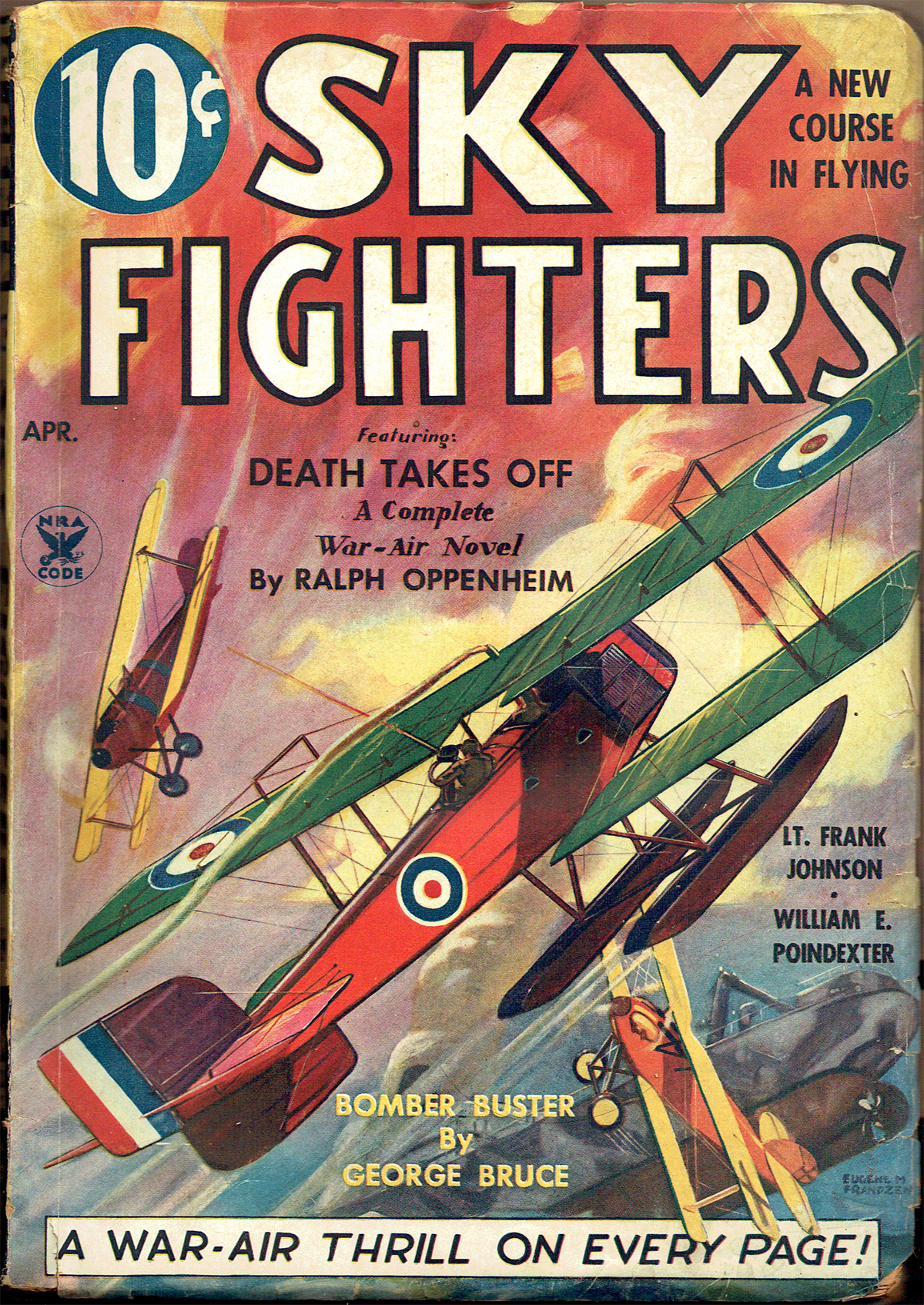
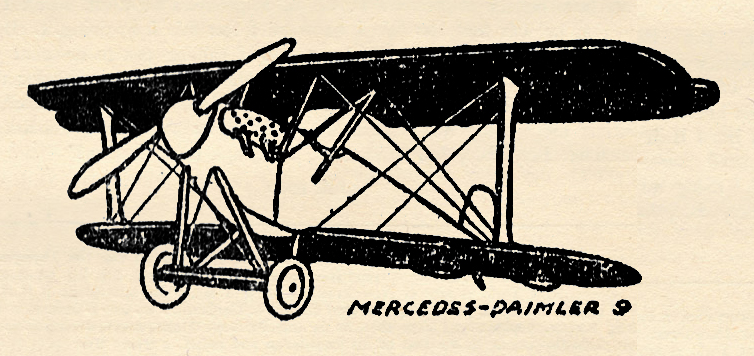
Eugene M. Frandzen painted the covers of Sky Fighters from its first issue in 1932 until he moved on from the pulps in 1939. At this point in the run, the covers were about the planes featured on the cover more than the story depicted. On the April 1935 cover, The Fairey N.9 F127 Seaplane takes on some Mercedes-Diamler 9s!

The Ships on the Cover

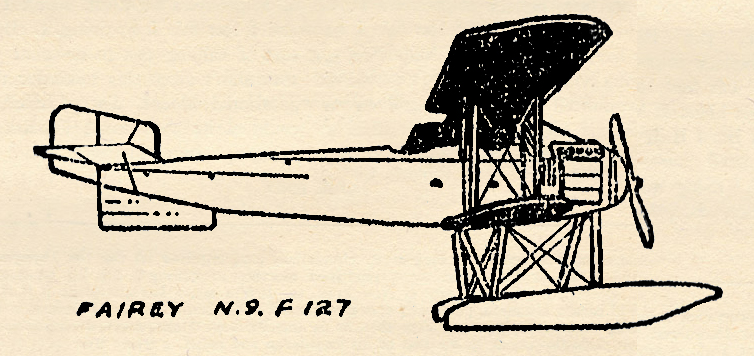
THE Fairey N.9. F127 is th_SF_3504the British seaplane in the foreground of this month’s cover. The two black-crossed scouts are German Mercedes-Daimler 9’s.

Fairey seaplanes were used to great advantage in patrolling the North Sea and did much to make that turbulent mass of water a comparatively safe area for friendly shipping. C.R. Fairey founded the firm bearing his name in 1916, after severing connections with the old Dunne Co. and the Short Bros., famous for their seaplanes dating back to 1910, so he was no newcomer to this field.

Slow Landing Possible

His trailing edge flaps gave his seaplanes mobility with heavy loads and made slow landings possible.

The original No. 9 Fairey seaplane has the distinction of being the first seaplane to begin an actual flight by being catapulted from the deck of a warship. But away back in 1912 the U.S. Navy used a catapult to launch a seaplane from a floating dock. Catapulting is a regular stunt on warships today, but back in the early days of aviation with crude gear and low-powered ships it took courage to climb into a cockpit and be shot into space.

The German Mercedes-Daimler Motorcar Gesellschaft manufactured Mercedes motors for many of the German planes. Their engine was so popular with the German fliers that the supply could not keep up with the demand. Evidently not content with doing a landoffice business with engines and being months behind with orders, they broke out in a rash of single and two place fighters which were fairly good ships but never got to first base in mass production.

Two of them were taken into the German Navy’s service and used as decoys.

It is an old racket to send out a plane or two over the battlefields to lure a few of the enemy’s planes into an unprotected position so that a superior number of planes may dive from the clouds and do their stuff; but on the sea the technique was a little different.

The two decoys took off and flew over a prearranged area of water. A lone freighter with anti-submarine guns is spotted. Immediately the two single-strutted ships go into action, sweeping back and forth over the tramp steamer’s decks, spraying it with burst after burst of Spandau lead. The ship’s crew drag out machine-guns and blaze back. Occasionally the anti-sub gun pops ineffectually at the heckling German planes. This air attack can do no vital harm to the steamer.

They’re Merely Decoys

Don’t forget that these Mercedes-Daimlers are merely decoys for a lurking submarine which slinks close to the freighter. They let go one torpedo at point blank range. The freighter shudders, lists—it is doomed. Men take to the boats. The sub quickly submerges. It has sunk a ship without the chance of being destroyed itself by the ship’s gunners.

A wireless flash from the doomed freighter was received by a British patrol cruiser. A catapult snaps the Fairey seaplane into the air. Its motor hurls the plane towards its enemies. It flies high, spots the German planes and swoops down with guns blasting. A surprise attack was staged by the sub on the freighter. The Fairey seaplane used surprise tactics also and in two minutes the Mercedes-Daimlers dove out of control to strike the water and sink in exactly the same spot where the stricken freighter has disappeared.

The Ships on The Cover
Sky Fighters, April 1935 by Eugene M. Frandzen
(The Ships on The Cover Page)

Next time, Mr. Frandzen features the Handley-Page and D.H.4!

“Lives of the Aces in Pictures – Part 44: Major Charles J. Biddle” by Eugene Frandzen

Link - Posted by David on November 8, 2017 @ 6:00 am in

Starting in the May 1932 issue of Flying Aces and running almost 4 years, Eugene Frandzen’s “Lives of the Aces in Pictures” was a staple of the magazine. Each month Frandzen would feature a different Ace that rose to fame during the Great War. This time around we have one of the great American Aces—Major Charles J. Biddle!

Major Biddle was one of that small number of American aviators who had actually had front line battle experience when his own country entered the war. Even before there were any indication of his own country taking part, he sailed for France and enlisted in the French Army, where he was eventually transferred for aviation tralning. When the La Fayette Escadrille was formed, he wan invited to become a member. In that organization he won his commission as a Lieutenant in recognition of his ability and courage.

When General Pershing formed the American Air Service and put Colonel William Mitchell in command of the air squadrons on the front, the able Colonel promoted Biddle to major and save him command of the 13th Pursuit Squadron, which he formed, organized and took to the front to make a distinguished record.

Though not supposed to lead his men in battle, he always did so. Just before the armistice, he left the 13th Squadron to become commander of the 4th Pursuit Group. By wars end he had amassed 7 victories and been awarded the Legion of Honor, Croix de Guerre, Distinguished Service Cross and Order of Leopold II.

After the war, Biddle wrote a book entitled The Way of the Eagle (1919) and joined the family law firm in 1924—becoming a partner by 1925 and a major force within the firm through the fifties.

He died in 1972 at “Andalusia”—the family estate on the Delaware River in lower Bensalem Township, Pennsylvania.

As a bonus—

“The Jerry Cracker” by C.M. Miller

Link - Posted by David on November 3, 2017 @ 6:00 am in

THIS week we have a story from the pen of C.M. Miller! Miller is known to Age of Aces readers as the author behind Chinese Brady, aa old war horse who’s fought in most every scrap there’s been. Here he presents a tale of a green pilot, Emmett Ralston, just up from training who can’t wait to get at the Huns! Problem is, circumstances seem to be conspiring against him.
You Can’t Graft Wings On A Prison Bunk, Or Bars Won’t Make A Fuselage—But Ralston Wanted A Crack At The Huns And No Prison Built Will Hold An-Ace-To-Be.

My Most Thrilling Sky Fight: Major Edward Mannock

Link - Posted by David on November 1, 2017 @ 6:00 am in

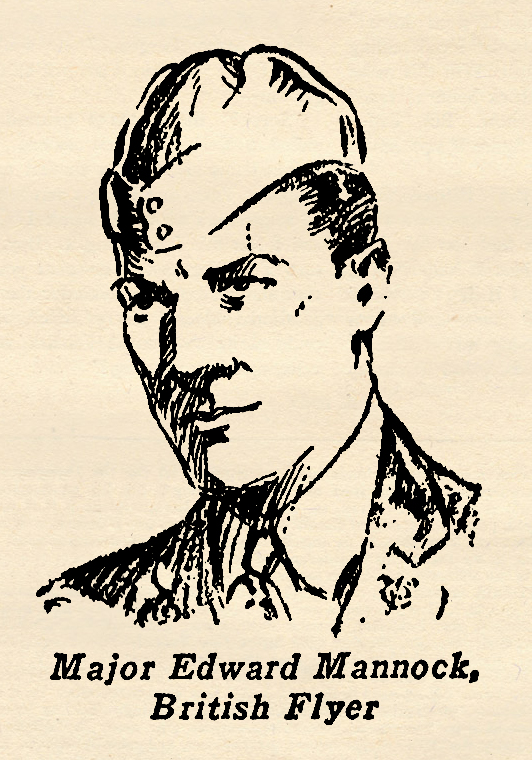
AMIDST all the great pulp thrills and features in Sky Fighters, they ran a true story feature collected by Ace Williams wherein famous War Aces would tell actual true accounts of thrilling moments in their fighting lives! This time we have British Flyer Major Edward Mannock’s most thrilling sky fight!

Edward “Micky” Mannock was serving the British postal department, Turkey, when the war broke out. He was immediately made a prisoner by the Turks, and spent almost a year in an enemy camp before he was repatriated to England in 1915. He first served in the Royal Engineers, was commissioned as a lieutenant and transferred to the flying Corps in August, 1916. Major McCudden, the great British Ace, was his first instructor.

At the end of the war Mannock ranked as the British Ace of Aces, with 76 victories to his credit, more than Bishop, Ball, or McCudden himself. Flying a Nieuport Scout he downed his first Hun June 7th, 1917. On July 25th, 1918, he got his 76th victory in an S.E.5. The next day he was seen to fall in flames behind the enemy lines. Before he was killed he was awarded the D.S.O. and the M.C, and was swiftly promoted to to the rank of Major. He was awarded the Victoria Cross posthumously. The following account of his fight with do enemy aircraft is taken from the report of a British journalist.


ONE AGAINST FORTY

by Major Edward Mannock • Sky Fighters, November 1935

I HAVE seldom been taken by surprise in the air. “Jimmy” McCudden schooled me well on that score in my early flight training. But one time I did get caught good and plenty. Forty Huns plopped in on me at once. I was flying solo over Villers-Bretteneux. It was a bad day for flying. There was rain and low-hanging clouds. The Huns had a big landing field at Villers, but our bombers had played it hot and heavy, and word came through to us that the Huns had abandoned it.

Right over the field there was a big hole in the clouds, so I dropped down for a look-see to ascertain the truth of the report. The field and hangars looked deserted. There was not an E.A. in sight. I dived low, got beneath the cloud layer. Then I saw why the field looked deserted. I had had the ill luck to drop down through that hole in the clouds just as the Hun staffels were leaving. Four flights of Huns had just left the ground, and were circling just beneath the clouds. The intervening clouds had hidden them from my view. When I did see them, it was too late for me to make my escape into the protecting clouds, for the Huns slid over on top of me.

There was nothing else for me to do but fight my way out of the trap.

Lead was rattling into my turtleback before I had a chance to shift into a climbing turn and bring my guns to bear upon any of the enemy. And one burst of slugs knocked my helmet askew so that my goggle glasses were wrenched across my eyes, blurring my vision.

When I did get them in place again, a purple-nosed Hun was diving at me head-on, both his Spandaus spewing out blue white streams. I maneuvered, pressed my trigger trips, then went up on one wing and slid down in an abrupt sideslip. The Hun ship shattered above me, exploded in flames. The blazing ship just missed mine as I nosed out of the slip. By now all the Hun planes had closed in tight on me.

But the Huns made one error. They hemmed me in so tight on all sides, above and below, that they couldn’t use their guns advantageously. I got two more of my attackers. But cheered as I was when I saw the E.A.5s fall, I knew that I couldn’t hold out against them for long. If I could pull up into the clouds, I knew I could lose them. Getting there was the problem. I went into a steep power dive, letting all that wanted to get on my tail. After a thousand foot dive, I pulled back on the stick and shot straight for the clouds.

Bullets raked my S.E. all the way down and up, but none of them had my name and address. I was just plain lucky, I guess, for I managed to make the clouds without getting popped. Once in them, I straightened out for my lines with all the sauce on. Believe me, my own airdrome looked good when I sat down there. I had got three of the full forty I had tangled with, but I didn’t regret not staying for more.

« Previous PageNext Page »